
The best fruits for weight loss get a bad reputation in diet circles. Some people cut them out entirely. Others eat unlimited amounts thinking they are always a free pass. Both approaches miss the point.
No fruit directly burns body fat. What certain fruits can do is make weight loss noticeably easier by improving fullness, delivering fiber, cutting calorie density, and helping you hold a calorie deficit without feeling deprived. For most people, that practical edge makes a real difference over weeks and months.
The truth sits in the middle: fruits can absolutely help you lose weight, and for most people, they make the process easier. But not all fruits work the same way, and portion size still matters.
This guide covers which fruits are genuinely useful for fat loss, why fiber and water content make them effective, which ones to moderate, and how to work them into a weight loss diet without overthinking it.
If you want to understand how fruits fit your total daily intake, our Calorie Deficit Calculator can help you estimate your personal target before you start.
Can You Eat Fruit While Losing Weight?
Yes, and most people should.
The fear around fruit usually comes from one thing: sugar. Fruit contains natural sugars, and some people assume that means it causes weight gain the same way candy or soda does. That comparison does not hold up.
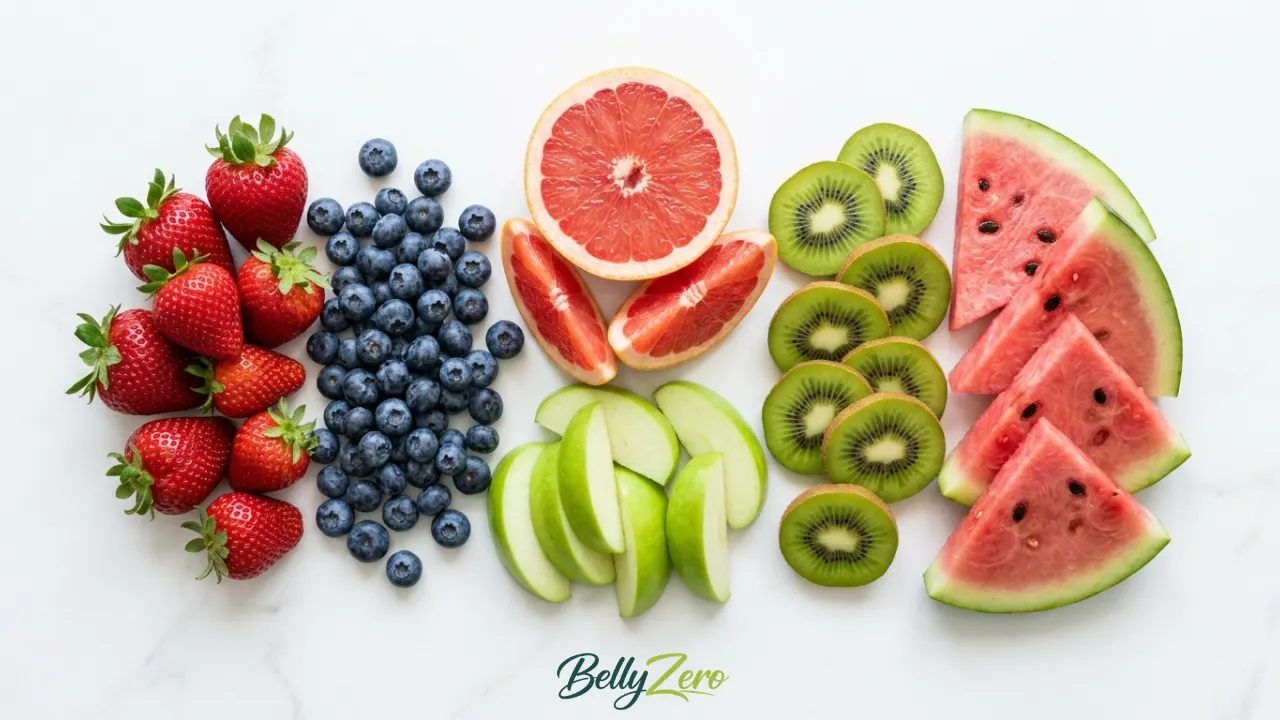
Whole fruit comes packaged with fiber, water, vitamins, minerals, and polyphenols that dramatically change how your body handles the sugar it contains. A cup of strawberries and a can of soda both have roughly 12 grams of sugar. Your body processes them completely differently.
That said, calories still count. Fruit is not calorie-free. Eating five bananas and three cups of grapes on top of your regular meals will push you over your calorie target. The goal is to use fruit strategically, not to treat it as a no-limit food.
Three things that make whole fruit different from processed fruit products:
- Whole fruit contains intact fiber that slows sugar absorption
- The water content fills physical space in your stomach
- Vitamins and antioxidants support metabolic function and reduce inflammation
Fruit juice, smoothies with lots of added fruit, and dried fruit are a different story. Those concentrate calories and remove the fiber that makes whole fruit effective. More on that later.
How Fruits Support Weight Loss
Fruits work through several distinct mechanisms, not just one.
Fiber Keeps You Full Longer
Dietary fiber slows the rate at which food leaves your stomach. That means you feel full for longer after eating a piece of fruit than you would after eating something with the same calories but no fiber.
Soluble fiber, found in apples, pears, and citrus fruits, forms a gel-like substance in the digestive tract that further slows digestion and blunts glucose spikes. Insoluble fiber, found in berry skins and seeds, adds bulk and moves through the gut faster.
Research consistently shows that higher fiber intake is associated with lower body weight, and the connection between fiber and weight loss is one of the most replicated findings in nutrition science.
A 24-year Harvard cohort study of 133,000 US adults found that people who increased fruit intake most lost the most weight, with high-fiber, low-glycemic fruits driving the strongest effect (Bertoia et al., PLOS Med. 2015).
One review found that increasing daily fiber by 14 grams was linked to a 10% reduction in calorie intake and about 1.9 kg of weight loss over roughly 4 months, without any other dietary changes (Howarth et al., Nutr Rev. 2001).
Lower Calorie Density
Calorie density refers to how many calories a food contains per gram. Most fresh fruits have very low calorie density because they contain so much water.
Watermelon is about 92% water. Strawberries are about 91%. When you eat high-water foods, you consume a large physical volume of food for very few calories. Your stomach stretches, satiety hormones respond, and your brain registers fullness.
You can eat 300 grams of strawberries for about 96 calories. Try getting the same fullness from 96 calories of crackers or chips.
Natural Snack Replacement
Most weight loss diets fail not at meals but between them. People reach for processed snacks, not because they are hungry but because they want something sweet, crunchy, or easy to grab.
Fruit replaces that habit with something that delivers sweetness, texture, and fullness at a fraction of the calorie cost of most packaged snacks.
Nutrient Density
Fresh fruit provides potassium, vitamin C, folate, magnesium, and a wide range of antioxidants. These nutrients support energy metabolism, reduce oxidative stress, and keep your body functioning well under the demands of an active weight loss program. A diet low in micronutrients tends to increase cravings as the body signals it needs more.

Best Fruits for Weight Loss
The table below is your quick reference for all 15 fruits covered in this guide. Each one is ranked and selected based on fiber content, calorie density, water content, and how well it fits real eating habits. Detailed breakdowns for every fruit follow immediately after the table.
| # | Fruit | Calories (100g) | Fiber (100g) | Why It Helps | Best Way to Eat |
|---|---|---|---|---|---|
| 1 | Raspberries | 52 kcal | 6.5g | Highest fiber-to-calorie ratio of any common fruit. Keeps hunger down for hours. | Fresh or frozen, plain or with Greek yogurt |
| 2 | Blackberries | 43 kcal | 5.3g | Very low calorie, high fiber, rich in anthocyanins that support fat metabolism. | Fresh, in salads, or mixed into oatmeal |
| 3 | Guava | 68 kcal | 5.4g | High fiber, high protein for a fruit, excellent vitamin C content. | Eaten whole with skin for maximum fiber |
| 4 | Apple | 52 kcal | 2.4g | Pectin (soluble fiber) slows digestion. Takes longer to eat, signals fullness. | Whole with skin, never peeled, as a snack |
| 5 | Pear | 57 kcal | 3.1g | High pectin and inulin content. One of the most filling fruits per calorie. | Whole with skin, or sliced with nut butter |
| 6 | Grapefruit | 42 kcal | 1.6g | Very low calorie density. High water content. Associated with appetite control in some research. | Halved and eaten fresh before a meal |
| 7 | Strawberries | 32 kcal | 2.0g | One of the lowest calorie fruits available. High volume, satisfying sweetness. | Fresh by the cup, in yogurt, or with cottage cheese |
| 8 | Kiwi | 61 kcal | 3.0g | Contains actinidin enzyme that improves protein digestion. Good fiber density. | Halved and spooned out, or sliced in bowls |
| 9 | Watermelon | 30 kcal | 0.4g | Lowest calorie fruit by volume. 92% water. High citrulline content. | Chilled slices as a snack or post-workout |
| 10 | Orange | 47 kcal | 2.4g | High vitamin C, good fiber when eaten whole. More filling than juice form. | Always whole, never as juice during fat loss |
| 11 | Papaya | 43 kcal | 1.7g | Contains papain enzyme that aids protein digestion. Anti-inflammatory properties. | Cubed fresh, or with a squeeze of lime |
| 12 | Blueberries | 57 kcal | 2.4g | Rich in anthocyanins linked to reduced fat storage. Low GI, high antioxidant load. | Fresh or frozen, with oatmeal or Greek yogurt |
| 13 | Peach | 39 kcal | 1.5g | Very low calorie, high water content, naturally sweet without spiking blood sugar. | Fresh with skin, or sliced into cottage cheese |
| 14 | Plum | 46 kcal | 1.4g | Contains sorbitol and isatin that support digestive regularity. Low GI of around 40. | Whole as a snack, or halved in salads |
| 15 | Cherries | 50 kcal | 1.6g | Low GI of around 22. Contains melatonin precursors. Anti-inflammatory polyphenols. | Fresh as a snack or post-dinner dessert replacement |
All nutritional values are per 100 grams, from USDA FoodData Central.
15 Best Fruits for Weight Loss: Detailed Breakdown
Here is everything you need to know about each fruit on this list. Why it works, what the research says, how many calories and grams of fiber you are actually getting, and the most practical way to eat it during a fat loss phase.
1) Raspberries
Raspberries sit at the top of this list for one straightforward reason: no common fruit delivers more fiber per calorie. Half a cup of fresh raspberries gives you roughly 4 grams of fiber for just 30 calories. That ratio is almost impossible to match with any other food.
The fiber in raspberries is a combination of soluble and insoluble types. The soluble fraction slows glucose absorption and keeps you feeling full well past the time you finish eating. The insoluble fraction adds bulk to digestion and keeps things moving efficiently, which matters for gut comfort during a calorie deficit.
Beyond fiber, raspberries are loaded with anthocyanins and ellagitannins, two classes of polyphenols with solid research behind them. A study published in Obesity found that diets rich in anthocyanins were associated with less visceral fat accumulation over time, independent of total calorie intake. Raspberries have one of the highest anthocyanin concentrations of any berry.
They also freeze exceptionally well, which matters practically. Frozen raspberries cost far less than fresh, taste just as good stirred into yogurt or oatmeal, and are available year-round. There is no reason to treat raspberries as a seasonal food.
Best use during fat loss: One cup of frozen raspberries stirred into plain Greek yogurt makes a high-protein, high-fiber breakfast under 250 calories. Hard to beat.
2) Blackberries
Blackberries are nutritionally close to raspberries but with an even lower calorie count per 100 grams. At 43 calories, you can eat a generous 200-gram portion for under 90 calories, with over 10 grams of fiber included. That is a remarkable return for the calorie cost.
The deep blue-black color of blackberries signals an exceptionally high anthocyanin content. Research published in the Journal of Nutrition has linked anthocyanin-rich diets to improved insulin sensitivity and reduced markers of metabolic inflammation, both of which are relevant when you are trying to lose fat and maintain energy on a reduced calorie intake.
Blackberries also contain a meaningful amount of vitamin C, vitamin K, and manganese. Manganese supports carbohydrate and fat metabolism at the enzyme level, making it a quietly useful micronutrient for anyone actively dieting.
One practical advantage blackberries have over some other berries is their flavor profile. They are naturally tart, which makes them satisfying without any added sugar. A bowl of blackberries rarely leads to overeating the way sweeter, lower-fiber foods tend to.
Best use during fat loss: Add a large handful to plain oatmeal with a tablespoon of ground flaxseed. You get fiber from three different sources and a breakfast that holds you comfortably through a four-hour gap.
3) Guava
Guava is one of the most nutritionally dense fruits on this list and one of the most underrated in Western weight loss conversations. A single medium guava contains around 3 grams of fiber and delivers more vitamin C than a large orange. The skin is edible and contains the highest concentration of both fiber and antioxidants, so peeling it is a nutritional mistake.
What makes guava particularly interesting for weight management is its protein content. At roughly 2.6 grams of protein per 100 grams, it has more protein than almost any other fruit. Protein contributes to satiety independently of fiber, which means guava gives you two separate fullness signals in one fruit.
The glycemic index of guava sits around 12 to 24 depending on ripeness, which is exceptionally low. Blood glucose rises slowly after eating guava, insulin response is modest, and energy is released steadily over time. For anyone who struggles with mid-morning energy crashes, guava eaten at breakfast is a genuinely useful option.
Research published in the American Journal of Cardiology found that regular guava consumption over 12 weeks was associated with reductions in total cholesterol, triglycerides, and blood pressure, while raising HDL cholesterol, adding meaningful cardiovascular benefits on top of the weight management case
Best use during fat loss: Eat one whole guava with the skin as a mid-morning snack. No preparation needed. Alternatively, slice and add to a salad with grilled chicken and lime dressing for a lunch with real staying power.
4) Apple
The apple earns its reputation as a diet staple, but the reasons behind that reputation are more specific than most people realize. The key compound is pectin, a type of soluble fiber that forms a thick gel in the digestive tract. Pectin slows stomach emptying significantly, which means the fullness from one apple lasts considerably longer than the fullness from the same calories in a different form.
A study published in Appetite found that whole apples increased satiety more than either applesauce or apple juice made from the same fruit, and reduced calorie intake at a subsequent meal by around 15%. The chewing itself plays a role: whole fruit takes time to eat, which allows satiety hormones to catch up with consumption before you reach for more.
The skin is non-negotiable. Most of the pectin and a significant portion of the polyphenols in an apple are concentrated in or just below the skin. A peeled apple is still useful but is a meaningfully inferior weight loss food.
Apples are also practical in a way that tropical fruits often are not. They are available everywhere, year-round, require no preparation, and can be transported and eaten anywhere. Building a weight loss habit around a food that travels well is an underappreciated advantage.
Best use during fat loss: Eat a whole apple with the skin 15 to 20 minutes before a meal where you know portion control is difficult. The pectin load will reduce how much you eat without requiring willpower.
5) Pear
Pears deliver slightly more fiber per 100 grams than apples, and they do it through a combination of pectin and inulin that makes them particularly effective for satiety. Inulin is a prebiotic fiber that feeds beneficial gut bacteria, supporting the kind of microbiome diversity that research increasingly links to healthier weight regulation.
A study published in Nutrition found that women who ate three pears per day lost significantly more weight over 12 weeks than those who ate an equivalent calorie load from oat cookies, despite both groups receiving the same dietary instructions. The fruit and oat groups had matched fiber and calorie counts, but differed substantially in energy density.
The researchers attributed the difference to the lower energy density of the fruit, meaning the pears provided far greater physical volume per calorie than the cookies.
Pears are one of the more filling fruits per calorie precisely because of that combination of pectin, inulin, and water. A medium pear (about 178 grams) delivers roughly 5.5 grams of fiber for around 100 calories. That is a meaningful fiber contribution in a single piece of fruit.
Like apples, pears should always be eaten with the skin. The skin contains a significant proportion of the total fiber and most of the polyphenols. Canning and processing destroy both, which is why fresh pears are the only useful form for weight loss purposes.
Best use during fat loss: Slice a cold pear over a bowl of cottage cheese with a pinch of cinnamon. You get fiber, protein, and a naturally sweet flavor combination that replaces a far higher-calorie dessert.
6) Grapefruit
Grapefruit is one of the lowest calorie whole fruits available, and it has attracted more weight loss research than almost any other fruit on this list.
The most frequently cited study, a randomized controlled trial published in the Journal of Medicinal Food, found that participants who ate half a fresh grapefruit before each main meal lost significantly more weight over 12 weeks than the control group, with the fresh grapefruit group losing 1.6 kg versus 0.3 kg in the placebo group.
It is important to understand what that study does and does not mean. Grapefruit does not burn fat. The likely mechanism is simpler: eating half a grapefruit before a meal adds water, fiber, and physical volume to your stomach before the higher-calorie food arrives.
That pre-meal bulk reduces how much you eat at the meal itself. The low calorie cost of the grapefruit means the net effect on your day’s intake is a reduction, not an addition.
There is also ongoing research into naringenin, a flavonoid in grapefruit that may have modest effects on insulin sensitivity and fat oxidation in animal models, but human evidence for this specific mechanism remains limited and preliminary.
One important practical note: grapefruit interacts with a number of medications, including some statins, certain blood pressure drugs, and several other common prescriptions. If you take any regular medication, check with your doctor before making grapefruit a daily habit.
Best use during fat loss: Eat half a fresh grapefruit about 20 minutes before your largest meal of the day. Avoid adding sugar. If the bitterness is an issue, a very small drizzle of honey adds minimal calories and makes it significantly more palatable.
7) Strawberries
Strawberries are the lowest calorie option on this list outside of watermelon, and unlike watermelon, they provide meaningful fiber alongside that low calorie count. A full cup of fresh strawberries, which is a genuinely satisfying portion, comes in at around 50 calories. You would need to eat almost six cups of strawberries to hit 300 calories.
That calorie-to-volume ratio makes strawberries one of the most practical weight loss fruits for anyone who struggles with portion psychology. When you can eat a large, colorful, sweet bowl of food for 50 to 60 calories, the deficit becomes much easier to maintain.
Strawberries are particularly high in vitamin C, with a single cup providing more than 100% of the daily recommended intake. They are also one of the best dietary sources of fisetin, a flavonoid with emerging research suggesting anti-inflammatory and metabolic benefits.
The glycemic index of strawberries sits around 41, which is low for a fruit, and their glycemic load per cup serving is only about 3.6. They do not meaningfully spike blood glucose for most healthy adults, and they have been studied specifically in people with type 2 diabetes with favorable results.
Frozen strawberries are nutritionally equivalent to fresh and cost significantly less. Keeping a bag in the freezer gives you a reliable low-calorie food option at all times.
Best use during fat loss: A cup of strawberries alongside two scrambled eggs makes a complete breakfast under 250 calories with solid protein and fiber. Alternatively, replace the dessert slot in your evening meal with a bowl of strawberries. The sweetness satisfies the craving at a fraction of the calorie cost.
8) Kiwi
Kiwi earns its place on this list through a combination of solid fiber content, a genuinely low glycemic index around 50, and a unique digestive advantage that most people are not aware of.
The kiwi contains actinidin, a proteolytic enzyme that helps break down dietary protein more efficiently in the stomach. For anyone eating a high-protein diet during fat loss, which is the correct approach for preserving muscle, better protein digestion means more of that protein actually gets used.
Two medium kiwis, a standard serving, provide around 90 calories and 4 grams of fiber. That is a meaningful fiber contribution at a moderate calorie cost. Kiwis are also exceptionally high in vitamin C and vitamin K, and they contain a good amount of potassium, which supports fluid balance and reduces bloating.
There is also credible research linking kiwi consumption to improved sleep quality.
A study published in the Asia Pacific Journal of Clinical Nutrition found that eating two kiwis an hour before bed for four weeks significantly improved sleep onset latency, waking time after sleep onset, and total sleep time in adults with self-reported sleep difficulties, with sleep onset latency reduced by 35.4% and total sleep time increased by 13.4%.
Sleep quality has a direct and well-documented relationship with weight loss. Poor sleep raises ghrelin, the hunger hormone, and suppresses leptin, the satiety hormone. Anything that improves sleep quality indirectly supports weight management.
Best use during fat loss: Two kiwis halved and eaten with a spoon make an ideal post-dinner snack. Low in calories, high in fiber and vitamin C, and potentially supportive of better sleep quality.
9) Watermelon
Watermelon has the lowest calorie count per 100 grams of any fruit on this list. At 30 calories and 92% water, it is the most effective food available for filling physical space in your stomach at near-zero calorie cost. A 300-gram serving, which is a generous portion by any standard, costs only 90 calories.
The fiber content is low, which means watermelon is not as independently satiating as berries or apples. The fullness it creates comes primarily from stomach stretch and volume rather than from the slow digestion that fiber produces. This means the fullness from watermelon does not last as long as the fullness from raspberries or a pear.
Where watermelon excels is as a heat-of-the-moment snack replacement and as a post-workout option. Its high water content supports hydration, and it is one of the best dietary sources of citrulline, an amino acid that the body converts to arginine, which supports blood flow and may reduce muscle soreness after exercise.
The glycemic index of watermelon sits around 72, which sounds alarming, but the glycemic load per standard serving is only about 5 because each serving is mostly water. The actual glucose impact is modest.
Best use during fat loss: Keep pre-cut watermelon chilled in the refrigerator for moments when you want something sweet and immediate. It satisfies the impulse to snack without meaningfully affecting your daily calorie total. It also works well as a post-workout recovery snack when you need quick carbohydrates and hydration.
10) Orange
The orange deserves more credit in weight loss conversations than it typically gets. A medium orange provides around 70 calories, 3.1 grams of fiber, and more than 100% of the daily recommended vitamin C, all in a package that takes several minutes to peel and eat. That eating time matters more than people realize.
The process of peeling and segmenting an orange slows consumption naturally. You cannot eat an orange quickly. That built-in pacing gives your satiety signals time to register before you have finished, which is a genuine practical advantage over foods that disappear in thirty seconds.
The white pith of the orange, the part most people try to remove, contains a significant amount of the fruit’s soluble fiber. Eating the orange with some pith attached rather than stripping it completely clean meaningfully increases the fiber you consume per fruit.
Oranges also contain hesperidin, a flavonoid that has been studied in the context of cardiovascular health and may have modest anti-inflammatory effects. They are one of the highest-volume, lowest-calorie natural sources of vitamin C available, which matters for immune function and collagen synthesis during periods of caloric restriction.
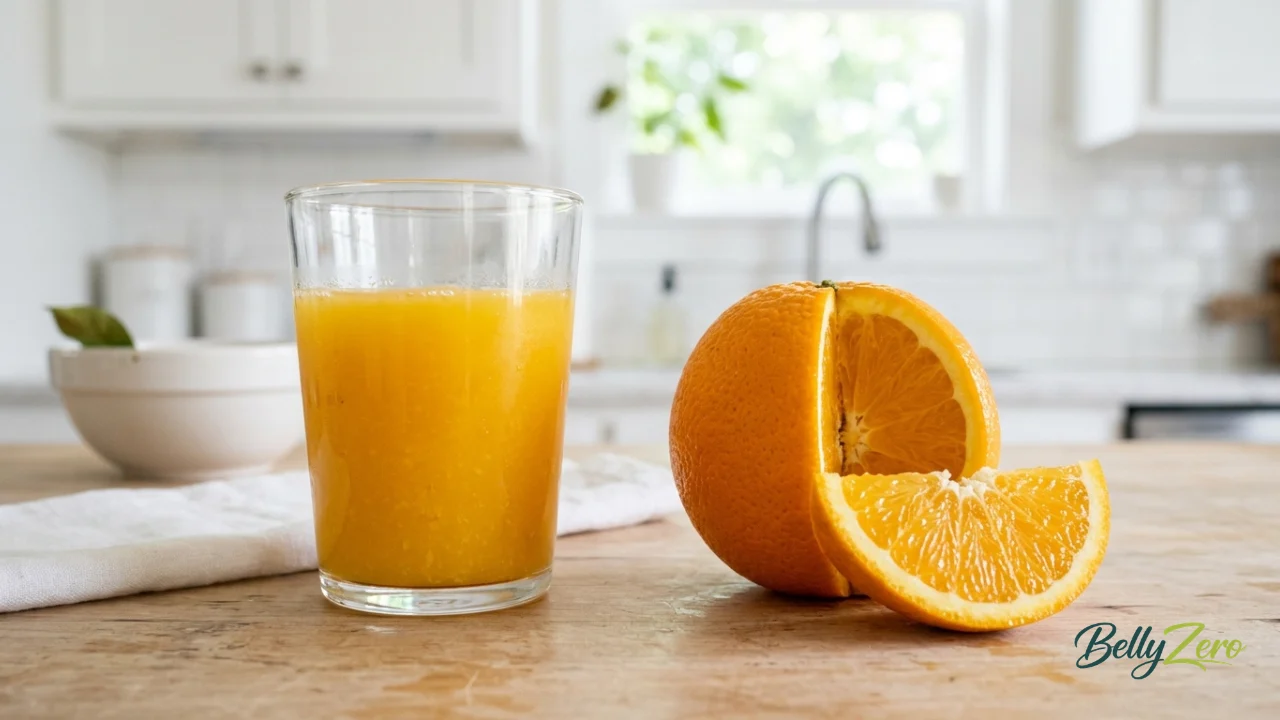
The critical rule: eat the orange, never drink it. A glass of orange juice contains the calories of three to four oranges with almost none of the fiber. The satiety effect disappears entirely.
Best use during fat loss: Eat a whole orange as a mid-afternoon snack when the energy dip and sweet cravings are at their strongest. The natural sugar and fiber combination addresses both simultaneously, and the peeling process keeps you occupied long enough for the satiety response to begin.
11) Papaya
Papaya sits at 43 calories per 100 grams with a pleasant sweetness and a unique digestive advantage that makes it particularly useful for anyone on a high-protein fat loss diet.
The fruit contains papain, a proteolytic enzyme that breaks down protein in the digestive tract. Higher protein diets, which are strongly recommended during fat loss to preserve lean mass, place increased digestive demand on the system. Papain supports that process and can reduce the bloating and discomfort that some people experience when they significantly increase protein intake.
Papaya is also one of the most anti-inflammatory fruits you can eat. It contains a combination of vitamin C, beta-carotene, lycopene, and flavonoids that collectively reduce markers of systemic inflammation. Chronic inflammation is increasingly recognized as a factor that can interfere with normal fat metabolism and make weight loss harder to maintain over time.
A cup of cubed papaya delivers around 55 calories, nearly 3 grams of fiber, and more than 100% of daily vitamin C and a significant fraction of daily vitamin A. That micronutrient density per calorie is exceptional.
The glycemic index of papaya is moderate at around 60, and the glycemic load per standard serving is low because of its high water content. It does not cause meaningful blood glucose spikes in most healthy adults when eaten in normal portions.
Best use during fat loss: Cube fresh papaya and squeeze lime juice over it. Eat it as a first course before lunch or dinner. The volume, fiber, and enzyme content make the subsequent meal easier to portion and digest.
12) Blueberries
Blueberries have one of the most substantial bodies of research behind them of any fruit on this list. Their deep blue-purple color comes from anthocyanins, and the concentration of these compounds in blueberries is among the highest in the food supply.
A study published in the Journal of Nutrition found that daily blueberry supplementation over 8 weeks was associated with reduced triglycerides, lower oxidative stress, and improved cardiovascular risk factors in 48 obese adults with metabolic syndrome. While blueberries alone did not cause dramatic weight loss, the metabolic improvements they supported make the overall calorie-deficit environment more effective.
At 57 calories per 100 grams and a glycemic index of around 53, blueberries provide meaningful sweetness at a low calorie cost with a moderate blood glucose response. A full cup of blueberries weighs about 148 grams and costs roughly 84 calories, with 3.6 grams of fiber included.
They are one of the most versatile fruits for daily use. Fresh blueberries in summer, frozen blueberries year-round, both are nutritionally equivalent. Frozen blueberries are often cheaper, always available, and work seamlessly in oatmeal, smoothies, and yogurt.
Best use during fat loss: Add three-quarters of a cup of frozen blueberries to plain oatmeal cooked in water. You get a breakfast with over 6 grams of fiber, real sweetness without added sugar, and a strong antioxidant load to start the day.
13) Peach
Peaches are one of the most underused fruits in weight loss diets. At 39 calories per 100 grams and roughly 88% water, a medium peach weighing around 150 grams delivers only 58 calories with a genuinely satisfying sweetness. For anyone who finds diet food unsatisfying, a ripe peach is a useful reminder that low-calorie eating does not have to mean flavorless eating.
The glycemic index of a peach sits around 42, which is low to moderate, and the glycemic load per fruit is only around 4 to 5. Peaches do not spike blood glucose meaningfully, even though they taste considerably sweeter than their numbers suggest. That sweetness-to-glycemic-impact ratio makes them excellent for managing sweet cravings without compromising blood sugar stability.
Peaches are a good source of vitamins A and C, potassium, and niacin. The skin contains most of the fiber and a meaningful portion of the polyphenols, so eating the fruit with the skin on is the correct approach for anyone focused on weight management. The flesh alone has a lower fiber content and less antioxidant value.
Peaches are also one of the highest-volume low-calorie fruits you can eat, which makes them effective for the physical satiety mechanism. When your stomach fills with food, stretch receptors signal fullness to the brain. A peach delivers that stretch signal at a very low calorie cost.
Best use during fat loss: Slice a fresh peach over cottage cheese for a high-protein, high-fiber snack under 200 calories. In the absence of fresh peaches, choose peaches canned in water, not syrup, which preserves the calorie advantage.
14) Plum
Plums are rarely discussed in weight loss content, which is a gap. A medium plum at around 65 grams contains roughly 30 calories and provides a satisfying combination of sweetness and tartness that makes it one of the more enjoyable low-calorie fruits to eat regularly. The low calorie count means you can eat two plums as a snack for around 60 calories and feel genuinely satisfied.
The glycemic index of fresh plums sits around 39 to 40, which is low. Despite their sweet flavor, plums cause a gradual and modest rise in blood glucose, making them appropriate for anyone monitoring insulin response during weight loss.
Plums contain sorbitol and isatin, two compounds that support digestive regularity. This matters practically because constipation is a common complaint during calorie restriction, particularly when protein intake is high and overall food volume is reduced. Regular plum consumption helps maintain gut motility without requiring supplementation.
Fresh plums are also rich in vitamin C, vitamin K, and potassium. The skin contains the majority of the fruit’s anthocyanins, which give plums their red or purple color and contribute to the anti-inflammatory profile of the fruit.
Dried plums, better known as prunes, are a different story for weight loss purposes. Drying concentrates the calories dramatically. A 30-gram serving of prunes has about 72 calories compared to roughly 30 calories in a medium fresh plum. Stick to fresh during a fat loss phase.
Best use during fat loss: Eat two medium plums as a mid-morning snack or pair one sliced plum with a small handful of almonds for a snack that combines fruit, fiber, healthy fat, and protein in one portable option.
15) Cherries
Cherries close this list with one of the most impressive glycemic profiles of any fruit. Fresh sweet cherries have a glycemic index of around 22, which is exceptionally low for a fruit that tastes as sweet as cherries do. Tart cherries score even lower. For anyone trying to manage blood sugar stability while eating in a calorie deficit, cherries are one of the best options available.
A cup of fresh cherries (about 138 grams) delivers roughly 87 calories and 2.9 grams of fiber. That is a moderate calorie count, but the low glycemic impact and high satisfaction of eating individual cherries one at a time makes portion control relatively natural. Cherries are not a food most people eat mindlessly.
Cherries contain melatonin and compounds that support melatonin production. Several small studies, including one published in the European Journal of Nutrition, found that tart cherry juice concentrate consumed twice daily significantly elevated melatonin levels and improved total sleep time and sleep efficiency in healthy adults over seven days.
Given the relationship between poor sleep and disrupted hunger hormones, fruit that supports better sleep is a meaningful weight loss ally beyond its direct nutritional profile.
Cherries are also rich in anthocyanins and quercetin, both of which have well-documented anti-inflammatory effects. For anyone exercising during a fat loss phase, the anti-inflammatory properties of regular cherry consumption may reduce muscle soreness and support faster recovery, making it easier to stay consistent with training.
Best use during fat loss: A cup of fresh cherries as a post-dinner dessert replacement is one of the most practical swaps on this list. Sweet, satisfying, and low enough in calories to fit within most evening calorie budgets. In the off-season, frozen tart cherries work well in overnight oats or as a topping for plain Greek yogurt.
Best High Fiber Fruits for Weight Loss
Fiber is the main reason fruit supports weight loss better than most other sweet foods.
How fiber works in practice:
When you eat soluble fiber, it absorbs water and forms a thick gel in your digestive tract. This gel slows how fast food moves through your stomach and into your small intestine. The result is a slower, more gradual release of glucose into your bloodstream, a longer period of physical fullness, and reduced hunger hormone activity.
Insoluble fiber adds bulk without absorbing water. It passes through relatively quickly, keeps digestion moving, and physically fills space in your stomach.
The top high fiber fruits ranked by fiber per 100g:
- Raspberries: 6.5g
- Guava: 5.4g
- Blackberries: 5.3g
- Avocado: 6.7g (technically a fruit, high in fat, different calorie profile)
- Pear: 3.1g
- Kiwi: 3.0g
- Apple (with skin): 2.4g
- Orange: 2.4g
- Strawberries: 2.0g
The general recommendation from nutrition researchers is 25g of fiber per day for women and 38g for men (Barber et al., Nutrients 2020, via PMC). Most Americans consume around 15g. Adding two or three high fiber fruits per day gets you meaningfully closer to those targets without dramatic dietary overhauls.
Low Calorie Fruits That Keep You Full
Low calorie density and high satiety are not the same thing, but the best fruits for weight loss deliver both.
Watermelon has only 30 calories per 100 grams, but because it is mostly water and not very filling beyond its volume, a small serving does not keep most people satisfied for long.
Raspberries have 52 calories per 100 grams but satisfy hunger much longer because of their fiber density.
The best low calorie, high satiety combination fruits:
Strawberries (32 kcal/100g): A full cup of strawberries is about 50 calories and takes several minutes to eat. The combination of chewing time, water content, and fiber keeps hunger at bay effectively.
Grapefruit (42 kcal/100g): Grapefruit is one of the most calorie-lean fruits available, and some research suggests it may support weight management when eaten before meals.
A randomized controlled trial published in the Journal of Medicinal Food found that participants who ate half a fresh grapefruit before each meal lost more weight over 12 weeks than those in the placebo group (Fujioka et al., J Med Food. 2006).
That said, grapefruit does not burn fat directly. Its advantages likely come from its very low calorie load, high water content, fiber, and possible effects on appetite. Individual results vary, and it should not be treated as a standalone weight loss solution.
Raspberries (52 kcal/100g): The highest fiber-to-calorie ratio of any common fruit. Half a cup provides 4 grams of fiber for about 30 calories.
Blackberries (43 kcal/100g): Very low calorie, high in anthocyanins, and satisfying for the calorie cost.
Papaya (43 kcal/100g): One cup of cubed papaya delivers nearly 3 grams of fiber and significant vitamin C for about 55 calories.
Fruits to Limit During Weight Loss (Not Avoid)
No fruit is forbidden. Calling any whole fruit off-limits is nutritionally excessive. But some fruits carry significantly more calories or sugar per serving, and during active fat loss phases, portion control with these matters more.
Bananas
A medium banana (about 118g) has 105 calories and 27 grams of carbohydrates. That is not excessive, but it is double the calorie count of a similar weight of strawberries. Bananas are excellent pre-workout fuel and high in potassium. The issue is not bananas themselves. The issue is eating three of them without accounting for those calories.
Mangoes
Mango is one of the most calorie-dense tropical fruits, with about 60 calories per 100 grams and 14 grams of sugar. A full mango can run 200 calories. Still nutritious. Worth eating. But a whole mango is a serving, not a garnish.
Grapes
Grapes are easy to overeat because they are small and require no preparation. A cup of grapes is about 100 calories, which is reasonable, but most people serve themselves well beyond a cup without realizing it. Grapes also have lower fiber content than berries, so they do not create the same level of satiety per calorie.
Dried Fruits
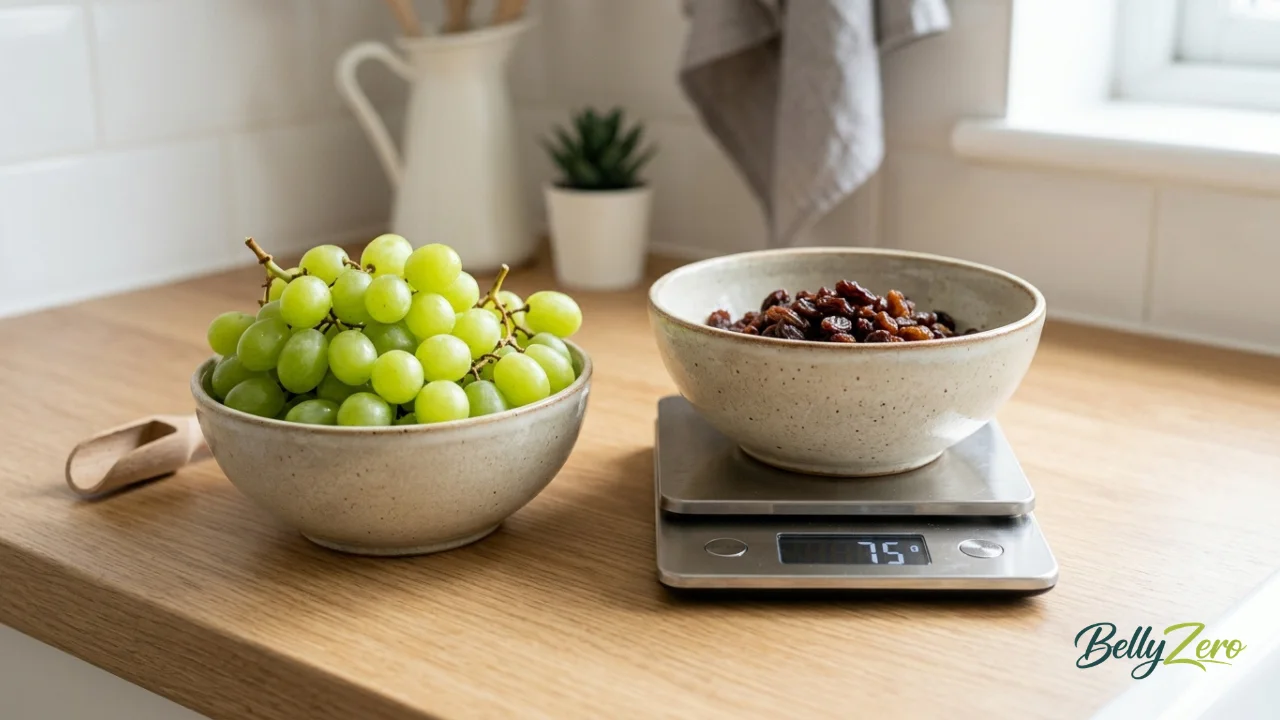
Raisins, dried mango, dried apricots, and similar products are concentrated calorie sources. Drying removes almost all water, which means 100 grams of raisins has around 299 calories versus about 67 calories in 100 grams of fresh grapes. The fiber stays intact, but the calorie density rises dramatically. Dried fruit is not a weight loss food in meaningful portions.
The practical rule: if you find yourself eating these fruits without measuring or tracking, build in a portion awareness habit. You do not need to eliminate them.
Whole Fruit vs Fruit Juice: Which Is Better for Weight Loss?
Whole fruit every time, and it is not close.
What juice removes:
Juicing or blending without pulp strips out nearly all the insoluble fiber from fruit. That fiber was doing most of the work. Without it, the natural sugars hit your bloodstream faster, blood glucose rises more sharply, insulin responds more aggressively, and hunger returns sooner.
A glass of orange juice (240ml) has roughly the same calories as three whole oranges but takes about ten seconds to consume versus several minutes for the fruit. You do not chew, your stomach does not physically fill the same way, and the fiber-mediated satiety signal never fires properly.
The glycemic index comparison:
A whole apple has a glycemic index of around 36. Apple juice sits around 44. The difference seems small, but for someone eating multiple fruit servings per day, those differences accumulate into meaningfully different insulin and hunger responses across a full day.
The glycemic index measures how quickly carbohydrate-containing foods raise blood glucose, and lower GI foods consistently produce smaller, more sustained energy responses (Ludwig, JAMA. 2002).
Smoothies:
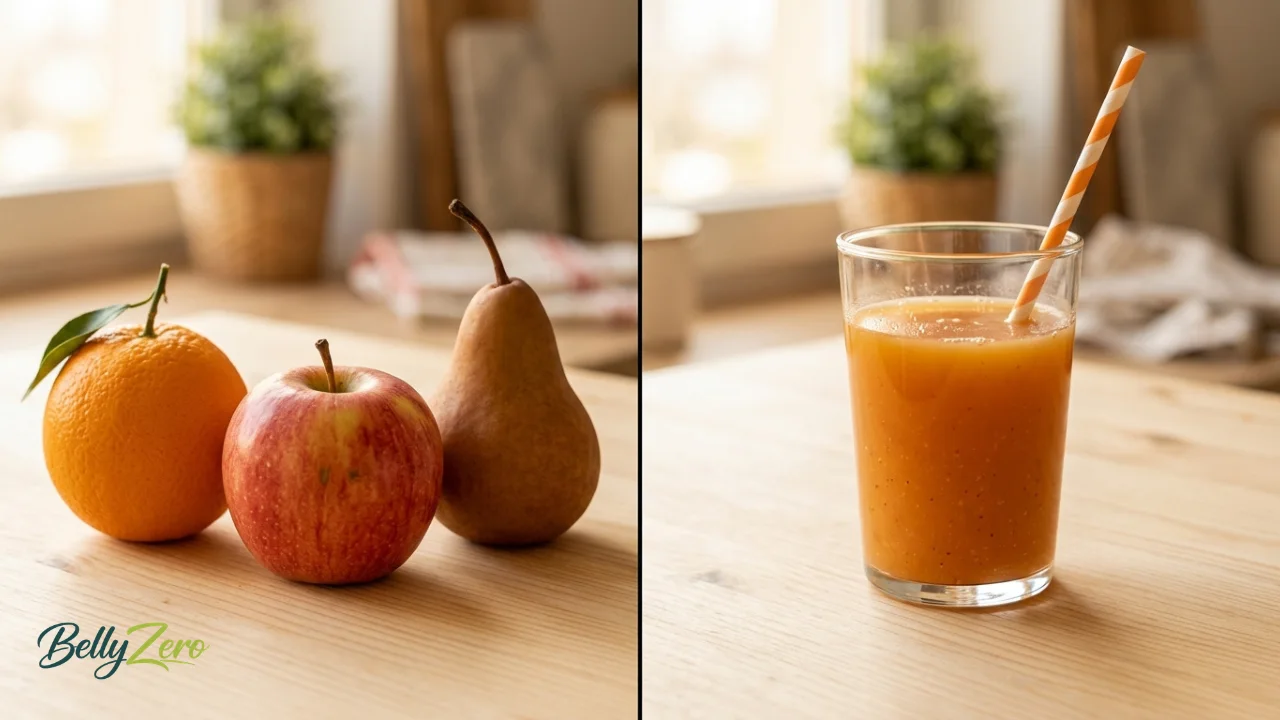
A smoothie with whole blended fruit sits between juice and whole fruit in terms of its blood sugar impact. The fiber stays in, but the chewing is eliminated. Research suggests that liquid calories do not trigger the same satiety response as solid food even when the nutritional content is identical. Smoothies can work in a weight loss plan, but they should not fully replace solid fruit servings.
The practical guideline: During active fat loss, eat your fruit whole. Save juice for occasional use rather than as a daily staple.
How Many Fruits Should You Eat Per Day for Weight Loss?
The USDA Dietary Guidelines recommend 1.5 to 2 cups of fruit per day for most adults on a 2,000 calorie diet. For active weight loss, that range still works well for most people.
A practical framework:
- 2 servings of whole fruit per day works well for most people in a calorie deficit
- One serving is roughly one medium piece of fruit, or one cup of berries or melon
- Prioritize high fiber options (berries, apples, pears) over high sugar, lower fiber options
- Count fruit calories as part of your daily total, not separate from it
If you track calories, berries are the most generous option. A full cup of raspberries is about 65 calories and provides 8 grams of fiber.
If you do not track calories, the safest approach is two servings of whole fruit per day, emphasizing variety rather than volume. Use our Body Fat Calculator to understand your current body composition, which can help you calibrate how aggressive your deficit needs to be.
Best Time to Eat Fruits for Weight Loss
The research on fruit timing is less conclusive than fitness culture suggests, but there are practical guidelines that hold up.
Morning:
Eating fruit in the morning helps you reach your daily fiber target early. Your digestion is active, and pairing fruit with protein (like eggs or Greek yogurt) stabilizes the blood glucose response and keeps hunger controlled through the late morning.
Before a Workout:
Fruit is an excellent pre-workout snack 30 to 60 minutes before exercise. The natural sugars provide quick, accessible fuel, and the fiber slows the glucose release enough that you avoid the blood sugar spike-and-crash that comes from processed carbohydrates. A banana or an apple are both practical choices.
Between Meals:
Fruit is one of the best between-meal snacks available because it delivers genuine satiety at low calorie cost. Eating fruit between meals is better for weight loss than skipping a snack entirely and arriving at your next meal ravenous.
Before Bed:
Eating fruit at night is not inherently harmful. Calories from fruit eaten at night count the same as calories from fruit eaten at noon. If fruit fits in your daily calorie target, eating it in the evening is not a problem. The idea that eating carbohydrates after a certain hour causes weight gain is not supported by current evidence.
The best time to eat fruit is whatever time you would otherwise reach for a less useful snack.

How to Add Fruits Into a Weight Loss Diet
Breakfast options:
- Stir a cup of frozen blueberries or raspberries into plain Greek yogurt with no added sugar
- Add sliced banana and a handful of strawberries to plain oatmeal cooked with water
- Eat a whole piece of fruit alongside eggs and avoid the morning pastry that fills the same slot
Snack replacements:
- Replace afternoon crackers with an apple and a tablespoon of almond butter
- Keep a container of cut melon in the fridge for grab-and-go snacking
- A cup of grapes with a small piece of cheese provides carbohydrate, fiber, and protein in one snack
Smoothies (done right):
- Use a base of one cup of frozen berries, half a banana, one scoop of protein powder, and unsweetened almond milk
- Do not add fruit juice, honey, or sweetened yogurt
- Treat smoothies as a meal or meal replacement, not an extra
With meals:
- Add sliced strawberries or mango to a spinach salad with grilled chicken
- Serve papaya or pineapple alongside grilled fish instead of heavy sauce
- Use sliced peaches or pears as a dessert rather than a baked sweet
The goal is substitution, not addition. Fruit works best for weight loss when it replaces a higher-calorie option, not when it stacks on top of an already full day of eating.
To understand how much protein you need alongside fruit-heavy snacking, our Protein Intake Calculator can help you set a daily target that preserves muscle during fat loss.
Fruits and Blood Sugar: What People Get Wrong
Natural sugar in fruit is not the same as added sugar in processed food, and this distinction matters considerably.
Natural vs added sugar:
Added sugar, like the high-fructose corn syrup in soda or the cane sugar in candy, arrives without any fiber, vitamins, or other nutrients. It hits your bloodstream quickly and does little to promote satiety.
Natural sugar in whole fruit arrives with fiber, water, and micronutrients that slow absorption and modulate the metabolic response. The glycemic response to whole fruit is significantly lower than to the same sugar consumed in refined form.
Glycemic index and glycemic load:
Glycemic index measures how quickly a food raises blood glucose. Glycemic load accounts for how much of that food you actually eat. Watermelon has a relatively high glycemic index around 72, which alarms people. But its glycemic load per typical serving is only about 5, very low, because a serving of watermelon is mostly water.
Whole berries, apples, and citrus fruits all have low to moderate glycemic indices and low glycemic loads. They do not spike blood sugar in the way that refined carbohydrates do for most healthy adults.
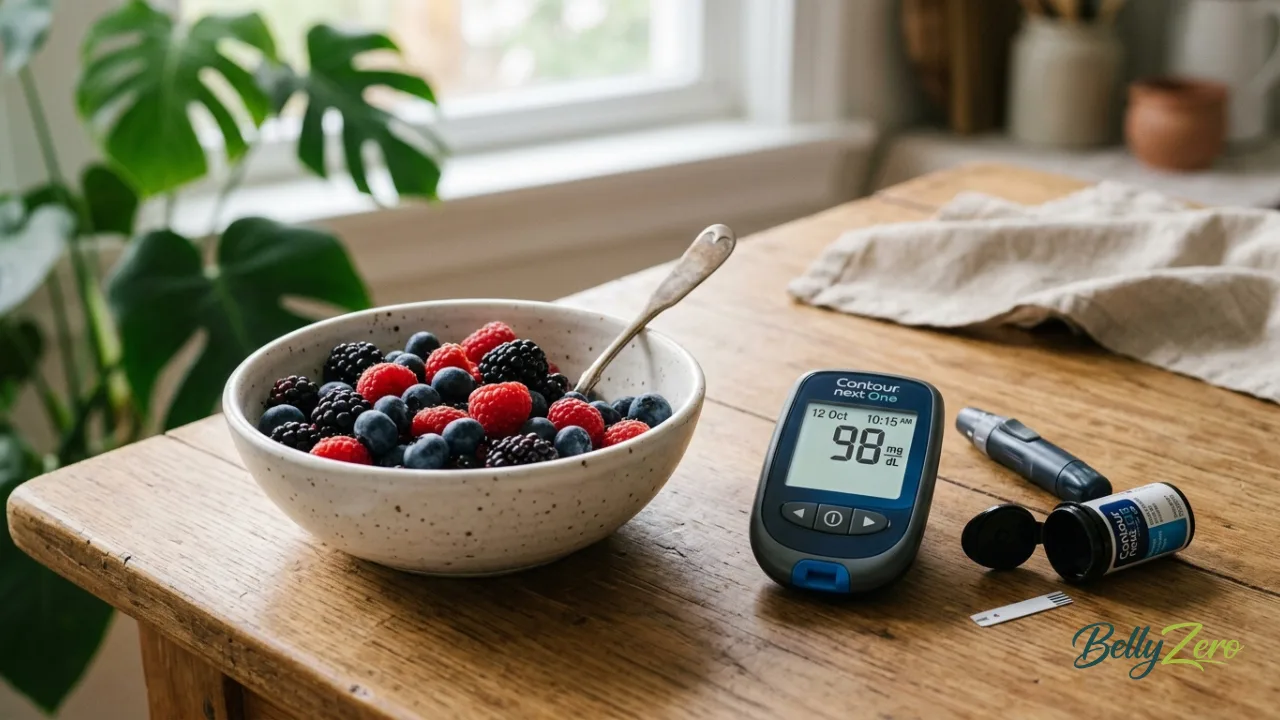
For people with prediabetes or type 2 diabetes:
Whole fruit is generally considered safe and even beneficial in most clinical guidelines, but portion awareness is more important. Low-sugar fruits like berries, kiwi, and grapefruit are the most useful starting points.
These low sugar fruits have minimal impact on blood glucose compared to tropical varieties. Anyone managing blood glucose with medication should consult their doctor before significantly changing fruit intake.
Best Fruits for Weight Loss at Night
Eating fruit at night does not automatically cause weight gain. The research is clear on this: total daily calorie intake matters far more than the specific time you eat. If a piece of fruit fits inside your daily target, eating it in the evening is not a problem.
That said, the type of fruit you choose at night can make a practical difference. Heavy or very high-sugar options eaten late may not be ideal if you find they trigger overeating. Whole fruits are always a better choice than juice at any hour, since the fiber slows digestion and keeps blood sugar steady.
Good evening fruit options:
Berries: Strawberries, raspberries, and blueberries are low in calories, high in fiber, and satisfying in a small portion. A cup of berries before bed is about 60 to 80 calories and provides several grams of fiber, which can keep you from reaching for a larger, less useful snack.
Kiwi: Two kiwis clock in around 90 calories with 4 grams of fiber. Some research also suggests kiwi consumption before sleep may support better sleep quality, which is relevant because poor sleep is independently associated with increased appetite and weight gain.
Apple: A medium apple provides about 4 grams of fiber and takes several minutes to eat, which helps prevent mindless late-night snacking. The chewing time and volume make it more satisfying than most packaged alternatives of similar calorie value.
Cherries: A cup of fresh cherries has about 87 calories and 3 grams of fiber. Tart cherries in particular contain melatonin precursors, which may support sleep, though the evidence is modest.
The common thread in all of these is fiber, volume, and a low calorie cost per serving. They give your evening snack habit somewhere useful to land without pushing you past your daily target.
Conclusion
Fruit is not your enemy in a weight loss program. For most people it is one of the most practical tools available: naturally sweet, low in calorie density, high in fiber, and filling enough to replace far worse habits.
The key points:
- Berries, apples, pears, and citrus fruits offer the best return on calories for weight loss
- Whole fruit outperforms juice every time because the fiber stays intact
- High-calorie fruits like bananas, mangoes, and grapes are still healthy foods, they just require more attention to portion size
- Two servings of whole fruit per day fits well into most weight loss calorie targets
- Pair fruit with protein to slow glucose absorption and extend fullness
Fruit works best as part of a broader strategy. Use our Calorie Deficit Calculator to understand your total daily target, and our Protein Intake Calculator to make sure you are eating enough protein alongside the carbohydrates from fruit. Those two numbers together give you a framework that makes eating fruit a clear advantage rather than a guessing game.
The best fruit is the one you will actually eat instead of reaching for something else.
Frequently Asked Questions
Does eating fruit help lose belly fat?
Which fruit burns the most fat?
Can I eat fruit at night while losing weight?
Are bananas bad for weight loss?
How many fruits should I eat daily for weight loss?
Are fruits better than packaged snacks for weight loss?
Can people with diabetes eat fruit?
Is fruit sugar bad for weight loss?
For informational and educational purposes only. All content on BellyZero, including articles, calculators, health tools, templates, and recipes, is intended to provide general health information. It does not constitute medical advice, a clinical diagnosis, or a substitute for professional healthcare guidance.
Results generated by BellyZero calculators and tools are estimates based on population-level formulas and standard reference ranges. They do not account for your full medical history, individual physiology, existing health conditions, or medications. Results may not apply to pregnant women, children, competitive athletes, or individuals with chronic illness.
Always consult a qualified healthcare professional before making changes to your diet, exercise routine, or health regimen based on anything found on this website. If you have symptoms or concerns about your health, seek medical attention promptly. BellyZero does not accept liability for decisions made based on content published on this site.
Written By: Vikas Arora Updated: June,2026