
Protein Calculator For Weight Loss
Use this free protein calculator for weight loss to get your exact daily protein target in grams. Based on your body weight, activity level, and guidelines from ISSN, ACSM, and WHO.
Fill in your measurements below to calculate your personalised daily protein target and calorie guidance for fat loss.
Calculate My Protein Target
These values reflect general daily protein needs for overall health and basic body function. They are not specifically designed for fat loss or muscle preservation during a calorie deficit.
Calculated using your body weight and estimated daily energy needs.
This range is designed to support fat loss while helping preserve lean muscle based on your body weight and activity level.
For effective weight loss, preserving muscle while losing fat is essential. Higher protein intake helps maintain lean muscle mass, reduce hunger, and improve consistency with your diet.
These recommendations are based on evidence summarized in position stands and research reviews from:
This section is provided as a practical reference to help you understand how calorie intake and protein work together during weight loss.
Fat loss primarily depends on maintaining a calorie deficit, while adequate protein intake helps support muscle preservation and better dietary adherence over time.
Just for your reference: The values below are an example based on your estimated needs. You can use them as a starting point and adjust based on your actual progress.
🔥Distributing protein across meals supports better satiety and muscle maintenance throughout the day.
- Greek Yogurt (low-fat / 0%)
- Lentils & Dal
- Paneer / Tofu
- Chickpeas & Rajma
- Protein Smoothies
- Low-fat Cottage Cheese
- Eggs / Egg Whites
- Chicken Breast
- Fish (Tuna, Salmon)
- Turkey Breast
- Shrimp / Prawns
- Skimmed Milk
Build your meals around these foods to meet your daily protein needs easily.
Opens your full report in a new tab. Set Destination → Save as PDF in the print dialog.
How the Calculator Works: Formulas and Sources
This calculator uses established formulas from peer-reviewed research, not estimates or general rules of thumb. Here is exactly what runs behind the results.
Step 1: Basal Metabolic Rate (BMR)
The calculator uses the Mifflin-St Jeor equation to estimate how many calories your body burns at complete rest. This formula was developed in 1990 from a study of 498 healthy adults and is considered the most accurate BMR prediction method for general-population adults.
For males: BMR = (10 x weight in kg) + (6.25 x height in cm) – (5 x age) + 5
For females: BMR = (10 x weight in kg) + (6.25 x height in cm) – (5 x age) – 161
Source: Mifflin MD, St Jeor ST, Hill LA, Scott BJ, Daugherty SA, Koh YO. A new predictive equation for resting energy expenditure in healthy individuals. Am J Clin Nutr. 1990;51(2):241-7.
Step 2: Total Daily Energy Expenditure (TDEE)
BMR is multiplied by an activity factor to estimate total daily calorie burn. The factors used are:
- Sedentary: 1.2
- Moderate (3 to 5 sessions per week): 1.55
- Active (daily training or physical job): 1.725
These are the standard published PAL (Physical Activity Level) multipliers used alongside the Mifflin-St Jeor formula.
Step 3: Fat Loss Calorie Target
The calculator subtracts 500 calories from your TDEE. A 500 calorie daily deficit produces approximately 0.5 kg of fat loss per week, which is consistent with guidelines from the American College of Sports Medicine. A minimum floor applies: 1,500 calories per day for males and 1,200 calories per day for females to prevent dangerously low intake.
Step 4: Protein Range for Fat Loss
Protein targets are calculated as grams per kilogram of body weight based on your activity level. The ranges used are:
- Sedentary: 1.2 to 1.6 g/kg
- Moderate: 1.4 to 1.8 g/kg
- Active: 1.8 to 2.2 g/kg
These ranges fall within the protein recommendations published by the International Society of Sports Nutrition (ISSN) and are consistent with the joint position of the Academy of Nutrition and Dietetics and the American College of Sports Medicine.
Source 1 (ISSN Position Stand, 2017): Jager R et al. International Society of Sports Nutrition Position Stand: Protein and Exercise. J Int Soc Sports Nutr. 2017;14:20.
Step 5: General Health Standards (WHO, CDC, ADA)
The results panel also shows three general health reference values so you can see how your fat loss target compares to baseline guidelines:
WHO minimum (0.83 g/kg): Based on the WHO/FAO/UNU 2007 joint technical report, which set the safe level of protein intake for healthy adults at 0.83 g/kg per day. Source: Joint WHO/FAO/UNU Expert Consultation. Protein and amino acid requirements in human nutrition. World Health Organ Tech Rep Ser.2007;(935):1-265.
CDC range (10 to 35% of calories): Based on the Acceptable Macronutrient Distribution Range (AMDR) for protein published by the Institute of Medicine in the 2005 Dietary Reference Intakes report. Source: Institute of Medicine. Dietary Reference Intakes for Energy, Carbohydrate, Fiber, Fat, Fatty Acids, Cholesterol, Protein, and Amino Acids. National Academies Press, 2005.
ADA ranges: Based on the activity-adjusted protein recommendations from the AND/DC/ACSM joint position statement referenced above.
Protein Calculator for Weight Loss: What You Need to Know
This protein calculator for weight loss gives you a personalized daily protein target in grams based on your body weight and activity level. It covers two things in one place: your general daily protein requirement for basic health, and your specific protein intake for fat loss, which is always higher. Both figures show up in your results so you always know exactly where you stand.
Most people trying to lose weight focus almost entirely on cutting calories. Protein is what they leave out. When your protein stays too low during a calorie deficit, your body starts breaking down muscle for energy instead of fat. That slows your metabolism, softens your results, and makes the weight harder to keep off. Getting your daily protein requirement right is the biggest nutrition variable separating people who lose fat from people who just lose weight.
Use the protein intake calculator above to get your number. It takes under 60 seconds.
Daily Protein Requirement for General Health
The standard minimum for daily protein intake in healthy adults is 0.83 grams per kilogram of body weight. The WHO and FAO set this figure through their 2007 joint technical report, and it is referenced by the CDC and the Academy of Nutrition and Dietetics as the baseline for healthy adult function.
At this level, your body has enough protein to maintain basic operations: tissue repair, enzyme production, immune support, and organ maintenance. This is the floor, not the target.
Here is the part most articles miss: 0.83 g/kg is a survival minimum, not a fat loss strategy. Research consistently shows this amount falls short for people in a calorie deficit who want to keep lean muscle intact. If your goal is fat loss, you need more.
A quick way to frame the three levels:
- 0.83 g/kg: Keeps basic body function running. Does not protect muscle during fat loss.
- 1.2 to 1.8 g/kg: Supports fat loss and muscle retention at moderate activity levels.
- 1.8 to 2.2 g/kg: Protects muscle for people training actively while in a calorie deficit.
Why Protein Matters More During Fat Loss
Losing weight and losing fat are two different things. When you cut calories without enough protein, your body loses both fat and muscle. A higher protein intake fixes this.
Here is exactly what happens when you eat enough protein during a calorie deficit:
Your muscles stay intact. Protein supplies the amino acids your muscles need to repair and maintain themselves. Without enough protein, muscle tissue breaks down. Less muscle means a lower resting metabolic rate, which makes continued fat loss harder every week that passes.
Your hunger drops. Protein suppresses hunger hormones like ghrelin more effectively than carbohydrates or fat. This makes it noticeably easier to stay in a calorie deficit without constant cravings.
You burn more calories digesting it. Protein has a thermic effect of around 20 to 30 percent, meaning your body burns more calories digesting protein than it does digesting fat (0 to 3%) or carbohydrates (5 to 10%). This adds up across an entire day.
Your body composition improves. Studies consistently show that people in a calorie deficit who eat more protein lose more fat and keep more muscle than those eating the minimum. The scale may show similar numbers for both groups, but the body inside looks and performs very differently.
The fat loss protein range sits between 1.2 and 2.2 grams per kilogram of body weight depending on your activity level. Use the protein calculator on this page to find your exact position within that range.
How Much Protein Do You Need for Weight Loss
Your daily protein target is personal. Two people of the same body weight can have completely different requirements depending on how active they are and how much lean muscle they carry.
Four factors determine your exact daily protein requirement:
Body weight. All protein recommendations scale from body weight in kilograms. Your total daily gram target moves directly with how much you weigh.
Activity level. The more you train and move, the more protein your muscles need to recover. A sedentary person needs less than someone training four days a week.
Size of your calorie deficit. A larger deficit raises your risk of muscle loss. Higher protein intake directly counters this, which is why people in aggressive deficits need to aim toward the upper end of the range.
Age. After around 40, the body becomes less efficient at using dietary protein to build and maintain muscle. This is called anabolic resistance. People over 45 need more protein per kilogram than younger adults to produce the same muscle-protecting effect.
Protein Targets by Activity Level
| Activity Level | Protein (g/kg/day) | 70 kg Example | Who This Applies To |
|---|---|---|---|
| Sedentary | 1.2 to 1.6 g/kg | 84 to 112 g/day | Desk job, light walking, little exercise |
| Moderate | 1.4 to 1.8 g/kg | 98 to 126 g/day | 3 to 5 exercise sessions per week |
| Active | 1.8 to 2.2 g/kg | 126 to 154 g/day | Daily training, intense cardio, or physical job |
Source: Jager R et al. ISSN Position Stand: Protein and Exercise.J Int Soc Sports Nutr. 2017;14:20. Read the study on PubMed
Protein Needs Change With Age
Protein requirements go up as you get older, not down. After around 40, muscle protein synthesis becomes less responsive to the same amount of dietary protein. This is a well-established clinical finding. Older adults who eat at the low end of protein recommendations lose noticeably more muscle during weight loss than younger adults eating the same amount relative to body weight.
| Age Group | Minimum (Health Baseline) | Fat Loss Range | Why It Increases |
|---|---|---|---|
| 18 to 30 | 0.8 g/kg | 1.4 to 1.8 g/kg | Peak muscle synthesis efficiency |
| 31 to 45 | 0.9 g/kg | 1.6 to 2.0 g/kg | Early anabolic resistance begins |
| 46 to 60 | 1.0 g/kg | 1.8 to 2.2 g/kg | Natural muscle loss accelerates |
| 60+ | 1.2 g/kg | 1.8 to 2.2 g/kg | Sarcopenia prevention becomes the primary concern |
Note: The protein calculator above uses activity-based ranges (1.2 to 2.2 g/kg) which apply across all adult age groups. The age minimums in this table reflect general health baselines only, not the fat loss targets the tool calculates.
Protein Intake for Women vs Men
The g/kg recommendations are the same for both genders. The difference comes from body composition, not gender itself. Men typically carry more lean muscle mass than women. For the same body weight, a man’s total daily protein requirement in grams is often higher because he has more muscle tissue to maintain.
Women tend to underestimate their protein needs because most general fitness content focuses on men. The fat loss protein range of 1.2 to 2.2 g/kg applies equally to women.
Women going through perimenopause or menopause benefit especially from aiming toward the upper half of the fat loss range (1.6 to 2.0 g/kg). Declining estrogen during this phase accelerates muscle loss, and combining higher protein with resistance training significantly slows this process.
The protein calculator on this page accounts for gender automatically when you enter your details.
Calorie Deficit and Protein: How They Work Together
Fat loss requires a calorie deficit. Protein protects your muscle while that deficit is in place. These two work as a team.
A 500 calorie daily deficit produces approximately 0.5 kg of fat loss per week. Without adequate protein, a significant portion of that weight loss comes from muscle instead of fat. With adequate protein, the body protects muscle and burns fat as the primary fuel source.
This is why tracking both calories and protein produces better results than tracking calories alone. Calories determine whether you lose weight at all. Protein determines how much of that lost weight was fat versus muscle.
People who diet without tracking protein often plateau faster, feel weaker over time, and find weight creeping back after they stop. This happens because muscle is being lost progressively, which lowers resting calorie burn each week.
The results panel of this protein intake calculator gives you both numbers at once: your calorie target and your protein range.
Practical Protein Strategy That Produces Results
Knowing your daily protein target is step one. Actually hitting it every day for weeks on end is where results come from. Here is a simple structure that works for most people:
Spread protein across 3 to 4 meals. Research shows the body responds better to protein distributed evenly through the day rather than concentrated in one or two large meals. Each meal should contain 25 to 40 grams of protein to activate muscle protein synthesis consistently.
Start the day with protein. A high-protein breakfast reduces hunger hormones for the rest of the day. People who eat 30 grams of protein at breakfast reliably consume fewer total calories across the day without consciously trying to.
Build each meal around the protein source first. Choose the protein first, then add vegetables, carbohydrates, and fats around it. This simple habit makes hitting your daily target much more consistent.
A practical daily split for a 140 gram target:
- Breakfast: 35 grams
- Lunch: 40 grams
- Dinner: 45 grams
- Snack: 20 grams
Adjust the split based on your personal target from the calculator.
High-Protein Foods for Fat Loss
You do not need supplements to hit your protein goal. Most people can reach their daily target through whole food alone.
| Food | Serving | Protein | Calories | Source |
|---|---|---|---|---|
| Chicken breast (grilled) | 100 g | 31 g | 165 kcal | Animal |
| Canned tuna (in water) | 100 g | 25 g | 116 kcal | Animal |
| Salmon (cooked) | 100 g | 25 g | 208 kcal | Animal |
| Eggs (whole, large) | 2 eggs | 12 g | 143 kcal | Animal |
| Greek yogurt (non-fat) | 170 g | 17 g | 100 kcal | Animal |
| Cottage cheese (low-fat) | 100 g | 11 g | 72 kcal | Animal |
| Lentils (cooked) | 1 cup (198 g) | 18 g | 230 kcal | Plant |
| Edamame (cooked) | 1 cup (155 g) | 17 g | 189 kcal | Plant |
| Chickpeas (cooked) | 1 cup (164 g) | 15 g | 269 kcal | Plant |
| Black beans (cooked) | 1 cup (172 g) | 15 g | 227 kcal | Plant |
| Tofu (firm) | 100 g | 8 g | 76 kcal | Plant |
| Whey protein powder | 1 scoop (30 g) | 24 g | 120 kcal | Supplement |
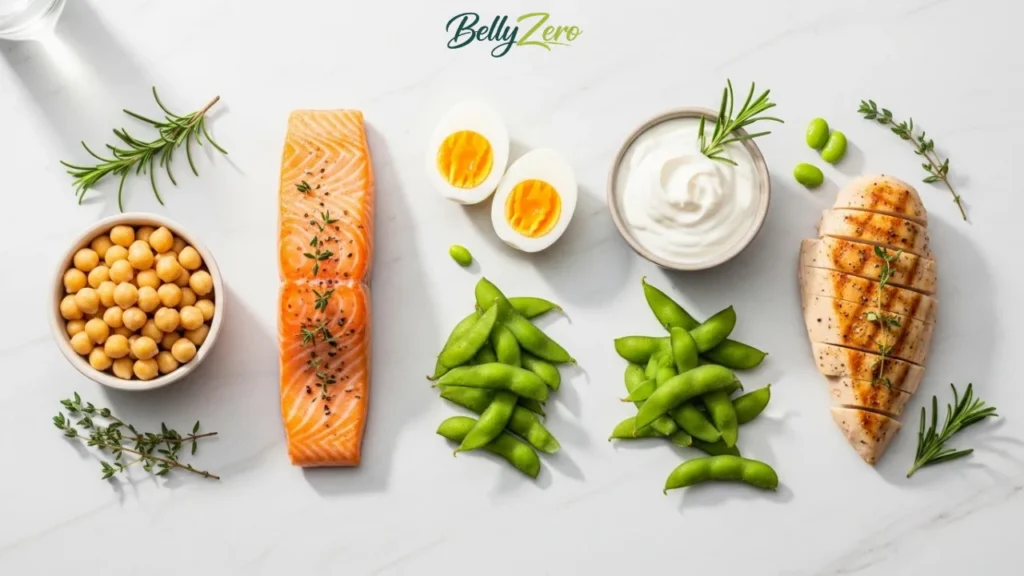
Practical high-protein meal combinations:
- Grilled chicken + chickpeas + leafy greens: approximately 46 grams
- 2 eggs + Greek yogurt + handful of almonds: approximately 35 grams
- Canned tuna + lentil salad + olive oil: approximately 43 grams
- Tofu stir-fry + edamame + brown rice: approximately 33 grams (plant-based)
These combinations also deliver fiber and healthy fats alongside the protein, which makes staying in a calorie deficit significantly easier from day to day.
Extra Protein During Pregnancy and Breastfeeding
Pregnancy and breastfeeding are not the time to cut protein. Your body works harder during these phases than at any other point, and both you and your baby need substantially more. Protein supports fetal development, placenta growth, and your own physical changes throughout.
| Stage | Extra Protein Needed | Total Daily Goal |
|---|---|---|
| Pre-pregnancy baseline | None | 46 to 60 g/day |
| Second trimester | +10 to 15 g/day | 60 to 80 g/day |
| Third trimester | +20 to 25 g/day | 75 to 100 g/day |
| Breastfeeding | +15 to 20 g/day | 70 to 90 g/day |
Always check with your doctor or a registered dietitian during pregnancy before making dietary changes.
Common Mistakes That Stall Fat Loss
Not eating enough protein while cutting calories. This is the most damaging mistake people make. Reducing calories without keeping protein high forces the body to break down muscle for energy. Weight drops on the scale but a large portion of that drop is lean tissue, not fat. The metabolism slows and all future progress becomes harder.
Copying someone else’s protein target. Protein targets scale with body weight. A 60 kg person and a 100 kg person have completely different daily requirements. Following a generic number you read online or copying a friend’s meal plan almost always puts you in the wrong range for your body.
Eating all your protein in one sitting. The body can effectively use around 25 to 40 grams per meal for muscle protein synthesis. Eating 150 grams in one meal wastes most of the excess. Spreading protein across three to four meals produces better results for the same total daily intake.
Stopping protein tracking after the first week. Consistency over weeks is what produces real fat loss results. People who track protein regularly for longer periods reliably outperform those who track briefly then quit.
Dropping protein once you reach your target weight. Protein matters just as much during maintenance as during fat loss. Reducing it after reaching your goal is one of the main reasons weight comes back, as muscle is gradually lost and appetite control weakens over time.
Other BellyZero Tools Worth Using
For informational and educational purposes only. All content on BellyZero, including articles, calculators, health tools, templates, and recipes, is intended to provide general health information. It does not constitute medical advice, a clinical diagnosis, or a substitute for professional healthcare guidance.
Results generated by BellyZero calculators and tools are estimates based on population-level formulas and standard reference ranges. They do not account for your full medical history, individual physiology, existing health conditions, or medications. Results may not apply to pregnant women, children, competitive athletes, or individuals with chronic illness.
Always consult a qualified healthcare professional before making changes to your diet, exercise routine, or health regimen based on anything found on this website. If you have symptoms or concerns about your health, seek medical attention promptly. BellyZero does not accept liability for decisions made based on content published on this site.
Written By: Vikas Arora Updated: April 2026