
Yes, you can build muscle in a calorie deficit. Research confirms this process, known as body recomposition, is real and achievable. The catch is that it works best under specific conditions: enough protein, consistent resistance training, and a moderate deficit. Skip any of those, and you will likely lose muscle instead of building it.
This article covers the science, who benefits most, how to set your numbers, and the most common mistakes that stall progress.
What Actually Happens in a Calorie Deficit
When you eat less than your body burns, it needs to find fuel. Most people assume that means muscle loss. That fear is understandable, but it misses a key part of the picture.
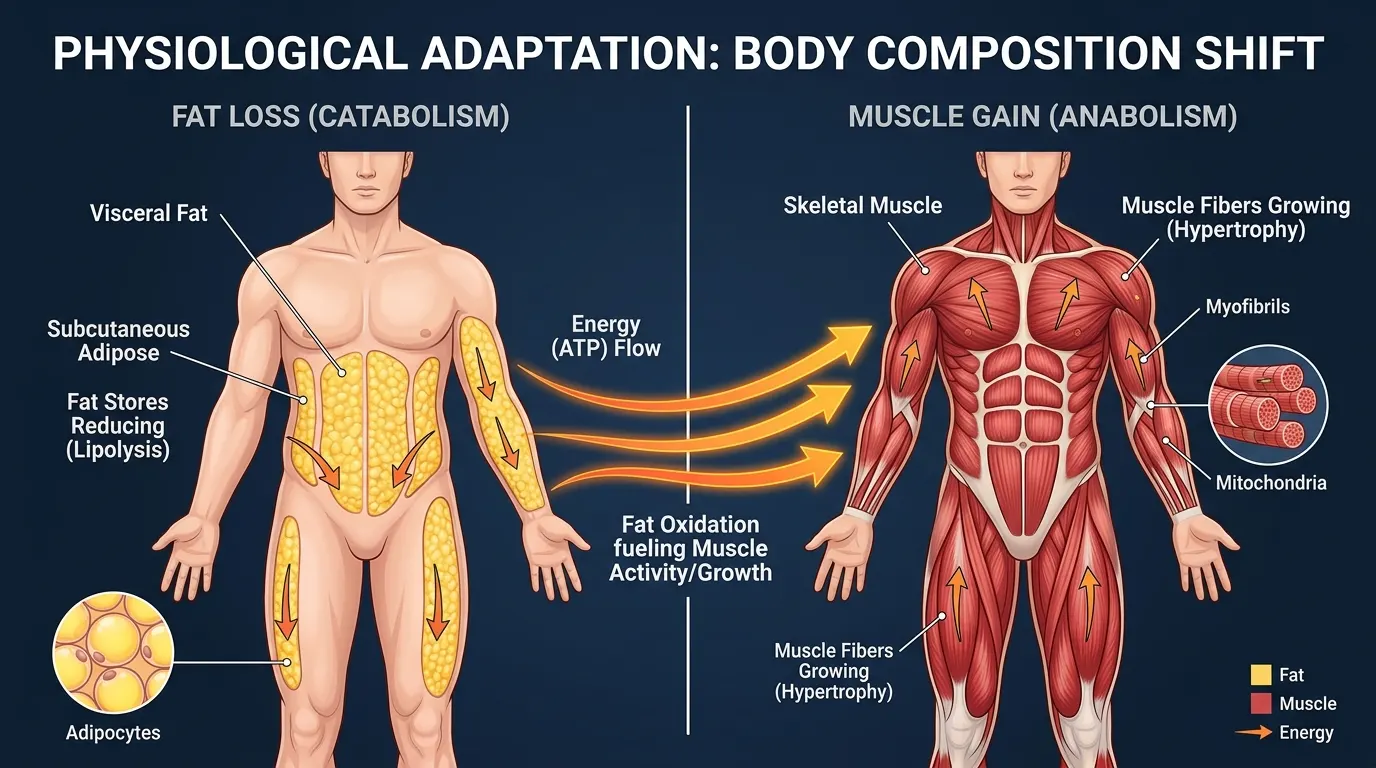
Your body stores energy in fat tissue, glycogen, and muscle protein. In a deficit, it draws from all three. What matters is the ratio. With adequate protein and a resistance training stimulus, your body preferentially burns fat and preserves, or in some cases adds, muscle tissue.
Three factors shift that ratio in your favor:
Protein intake gives your body the amino acids it needs to build and maintain muscle even while running an energy deficit.
Resistance training sends a direct signal to your muscles to stay. Without that signal, the body treats muscle as surplus tissue it does not need to maintain.
Deficit size matters because extreme restriction may suppress anabolic hormone activity and impair recovery, making muscle retention harder. A moderate deficit keeps these systems functioning closer to normal.
The Science Behind Body Recomposition
Body recomposition means losing fat and building muscle at the same time. Traditional fitness advice treats bulking and cutting as separate phases, but controlled research shows both can happen together.
A study published in the American Journal of Clinical Nutrition found that participants in a calorie deficit who consumed a high-protein diet and performed resistance training were able to lose fat while increasing lean mass. In a controlled trial, young men followed a 40% calorie deficit with very high protein intake (about 2.4 g/kg bodyweight) alongside intensive training, resulting in simultaneous fat loss and improvements in lean body composition over a four-week period.
The mechanism comes down to two competing processes: muscle protein synthesis (building) and muscle protein breakdown (breaking down). In a deficit, both slow down. But with high protein and consistent training, synthesis can still outpace breakdown. Fat fills the energy gap.
Body recomposition is not a loophole or a fitness myth. It is basic metabolic biology with solid research backing it.
Who Can Build Muscle in a Calorie Deficit
Your starting point is probably the biggest factor in how well this works for you.
Beginners respond to resistance training very aggressively, even in a deficit. The training signal is strong enough to drive muscle growth regardless of calories. This is what people mean by “newbie gains.”
People returning after a break benefit from muscle memory. Rebuilding previously held muscle is faster and requires fewer resources than building from scratch.
People with higher body fat have more stored energy to draw from. Their bodies are better positioned to burn fat for fuel while building muscle, making a deficit more practical.
Intermediate and advanced lifters can still achieve body recomposition, but the results come more slowly. Lean, experienced athletes who are close to their genetic potential may find that separate bulking and cutting cycles produce better results.
| Who You Are | Recomposition Potential | Expected Timeline |
|---|---|---|
| Complete Beginner | Very High | Noticeable in 8 to 12 weeks |
| Returning After a Break | High | Muscle memory speeds things up |
| Higher Body Fat (Untrained) | High | Steady with correct diet and training |
| Intermediate Lifter | Moderate | Slow, requires consistent effort |
| Advanced and Lean Lifter | Low | Very slow, separate phases may work better |
Can Women Build Muscle in a Calorie Deficit?
Yes. The core physiology of body recomposition applies to women the same way it applies to men. High protein intake, progressive resistance training, and a moderate deficit produce the same fundamental result: fat loss alongside muscle retention or growth.
The differences are worth knowing, though. Women generally have lower testosterone levels than men, which may contribute to a slower rate of muscle gain overall. However, research consistently shows that women respond well to resistance training and can achieve meaningful body recomposition in a deficit.
A study published in The journal of Nutrition confirmed that women in a calorie deficit who consumed high protein and trained with weights improved their lean mass while reducing body fat.
Women should also be aware that menstrual cycle phase can affect energy levels, recovery, and performance. Tracking how you feel and perform across the month helps you adjust training intensity when needed, rather than fighting through phases where the body is less primed for high output.
Protein targets remain the same: aim for 1.0 to 1.2 grams per pound of bodyweight. The training approach is identical. The process just takes longer, and that is completely normal.

How Much of a Deficit Works Best
Deficit size is one of the most important variables for body recomposition, and getting it wrong in either direction creates problems.
A deficit that is too large, say 1,000 or more calories per day, tends to impair recovery, reduce training performance, and make it harder to hold onto muscle. It may also negatively affect hormonal and metabolic adaptations over time.
A deficit that is too small produces minimal fat loss and can make progress feel slow or insignificant.
Research in the Journal of the International Society of Sports Nutrition suggests that a moderate, sustainable energy deficit combined with high protein intake and resistance training is the most effective approach for preserving lean mass during fat loss. In practice, this typically results in a gradual rate of fat loss of around 0.5 to 1% of bodyweight per week, which is generally considered optimal for maintaining performance and muscle mass.
Individuals with higher body fat can often tolerate a larger deficit, since stored energy reserves help offset some of the energy gap, while leaner individuals generally benefit from a more conservative approach.
Protein Is the Most Important Variable
If only one thing determines whether you build or lose muscle in a deficit, it is protein intake.
Protein supplies the amino acids your body needs for muscle protein synthesis. It is also the most satiating macronutrient, which helps with hunger during a calorie deficit. It has a high thermic effect too, meaning your body burns more calories digesting it compared to carbs or fat, roughly 20–30% of protein calories are burned during digestion itself.
For general exercising individuals, the International Society of Sports Nutrition recommends a daily intake of 1.4–2.0 g of protein per kilogram of bodyweight. However, for people specifically training in a calorie deficit, the same position stand notes that higher intakes of 2.3–3.1 g/kg/day may be needed to maximize the retention of lean body mass.
For a 170-pound (77 kg) person training in a deficit, that works out to approximately 177–239 grams of protein per day. Spreading that protein across three to five meals produces better muscle protein synthesis outcomes than eating the same total in one or two large sittings. Research published in the Journal of Physiology found that consuming a moderate amount of protein at each meal stimulated 24-hour muscle protein synthesis more effectively than skewing protein intake toward the evening meal.
Good sources with high leucine content, which directly triggers muscle protein synthesis, include chicken breast, eggs, Greek yogurt, canned tuna, cottage cheese, and whey protein.

How to Train in a Deficit
Diet alone does not build muscle. Training gives the body its reason to hold onto and build muscle tissue. Without that signal, even a good diet mostly slows the muscle loss rather than reversing it.
Progressive overload is the core principle. Consistently challenge your muscles by adding weight, doing more reps, or reducing rest. You may not set personal records every week in a deficit, but strength performance should hold steady or improve over longer time frames.
Compound movements are the most efficient use of training time during a deficit. Squats, deadlifts, bench press, rows, and overhead presses recruit multiple muscle groups and produce the strongest training stimulus per session.
Training frequency matters. Research in the Journal of Strength and Conditioning Research suggests that training each muscle group at least twice per week can be beneficial for hypertrophy, primarily because it allows better distribution of weekly training volume and recovery. However, when total weekly volume is matched, differences between once and twice weekly training are minimal.
Cardio supports fat loss and heart health, but too much increases recovery demand. Favor moderate-intensity steady-state cardio like walking or cycling. Limit high-intensity cardio to two or three shorter sessions per week.

Common Mistakes to Avoid
Cutting too aggressively. Dropping to very low calorie intake, like 1,000 to 1,200 calories, makes muscle retention far harder, tanks gym performance, and is nearly impossible to sustain. A moderate deficit works better over time.
Letting protein drop. Some people cut carbs or fat to hit a calorie target and unintentionally reduce protein too. Always protect protein first. Adjust carbs and fat around it.
Switching to only light, high-rep work. Heavy compound lifting is what signals your body to preserve and build muscle. Removing that signal removes the adaptation.
Ignoring sleep. Growth hormone peaks during deep sleep, and sleep restriction measurably reduces fat loss and lean mass retention during a deficit. A University of Chicago study found that cutting sleep significantly reduces the proportion of weight lost from fat versus lean tissue.
Using scale weight as your only progress marker. During body recomposition, the scale often stays flat because fat loss and muscle gain offset each other. Monthly measurements, progress photos, and gym performance give a much clearer picture.
The Bottom Line
Yes, you can build muscle in a calorie deficit. The research is clear on this. What separates people who pull it off from those who just lose weight and feel depleted comes down to three things: a moderate deficit, high protein intake, and consistent resistance training.
Your starting point shapes how fast it works. Beginners and people with higher body fat see the fastest results. Advanced, lean athletes see it work slowly if at all and may do better with separate phases. Track the right things. The scale is a weak signal during body recomposition. Monthly photos, measurements, and gym performance tell you what is actually happening.
Frequently Asked Questions
For informational and educational purposes only. All content on BellyZero, including articles, calculators, health tools, templates, and recipes, is intended to provide general health information. It does not constitute medical advice, a clinical diagnosis, or a substitute for professional healthcare guidance.
Results generated by BellyZero calculators and tools are estimates based on population-level formulas and standard reference ranges. They do not account for your full medical history, individual physiology, existing health conditions, or medications. Results may not apply to pregnant women, children, competitive athletes, or individuals with chronic illness.
Always consult a qualified healthcare professional before making changes to your diet, exercise routine, or health regimen based on anything found on this website. If you have symptoms or concerns about your health, seek medical attention promptly. BellyZero does not accept liability for decisions made based on content published on this site.
Written By: Vikas Arora Updated: June, 2026