
The only guide you need to find the best foods for weight loss, ranked, explained, and built into a system that actually works.
You already know the basics: eat more vegetables, cut sugar, and drink water. But you are still stuck, still frustrated, and still searching for something that actually works.
This is not another food list. This is a complete fat loss system built around one simple truth: the right foods do not burn fat; they control hunger, and when you control hunger, fat loss becomes inevitable.
Inside this guide you will find 100+ foods ranked by satiety score, a meal-building formula you can use starting today, a visual breakdown of what 300 calories actually looks like, and a diagnostic checklist that tells you exactly why your current diet is failing you. No supplements, no extreme restriction, no guesswork.
You Have Tried Everything. Nothing Works. Here Is Why.
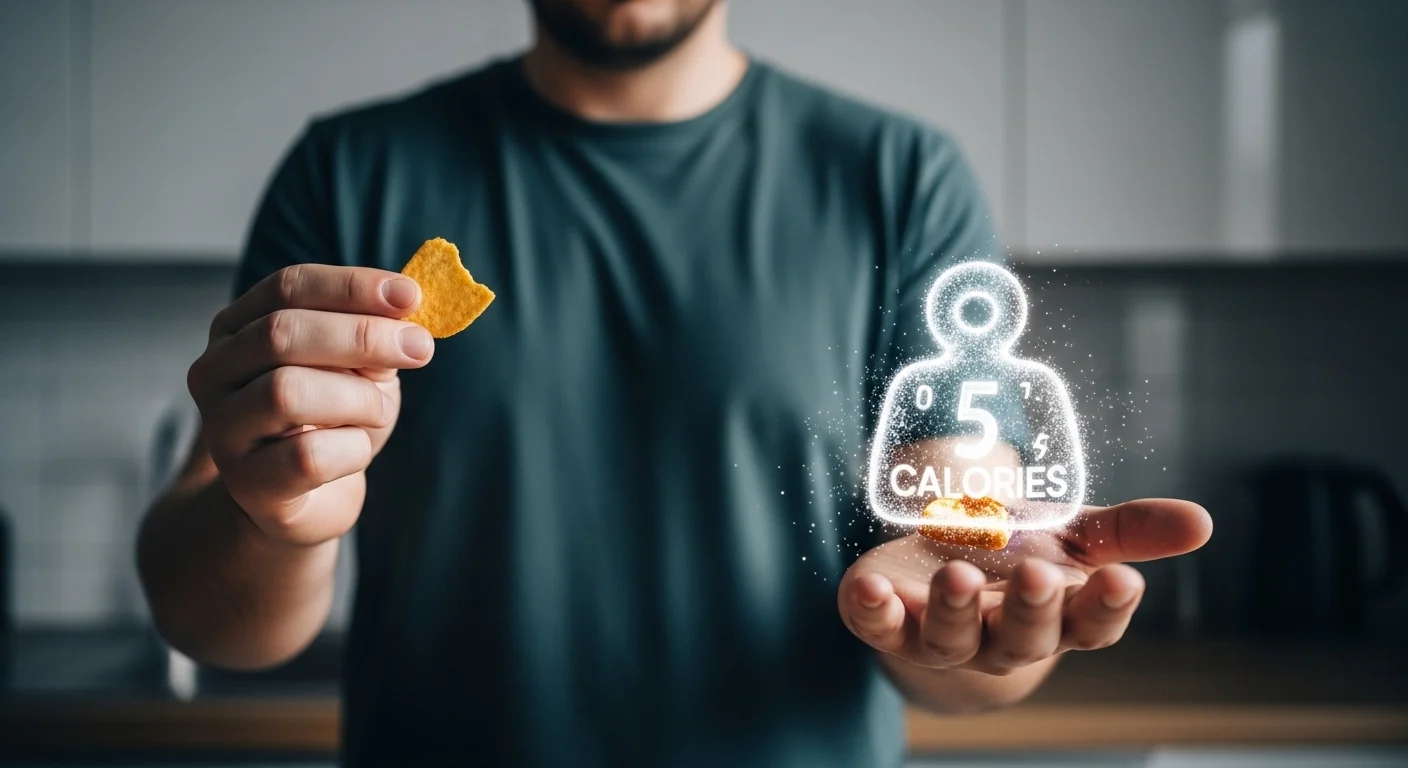
It is 10:30 PM and you are standing in your kitchen, fully aware that you already had dinner two hours ago, but something keeps pulling you back. You are not hungry in the traditional sense. You just want something, and you cannot explain why.
You grab a handful of chips, then another, and you tell yourself it is just this once, but somewhere in the back of your mind you already know it is not.
The next morning the guilt hits, and you open your phone and Google “best foods for weight loss” for what feels like the hundredth time. You find the same list you always find: broccoli, chicken breast, green tea, and avocado. You already know all of this, so the real question worth asking is why it is still not working.
THE REAL PROBLEM:
You do not have an information problem. You have a system problem. You know what to eat, but you do not know how to eat in a way that stops you from eating too much, and that one gap is the reason most diets fail before they ever really begin.
Here is what nobody in the weight loss industry wants to admit: there is no food on earth that burns fat. Not green tea, not apple cider vinegar, not grapefruit, and not any supplement with a dramatic name and a price tag to match. These are myths built to sell products and generate clicks, and they have been distracting people from the actual solution for decades.
Fat loss happens when you consistently eat fewer calories than your body burns, and that is the complete science of it. What makes this process dramatically easier or harder, though, is the specific foods you choose, and that is exactly what this guide is about.
This is a system, not a list, and it is designed to help you eat less without feeling starved, make smarter choices without obsessing over every meal, and finally understand why some foods keep you full for five hours while others leave you reaching for a snack within 45 minutes.
The goal is not to eat less. The goal is to feel full on less.
Keep that sentence with you as you read through this guide, because it will fundamentally change the way you think about food and make every decision that follows far easier than it has ever been.
The Truth About Weight Loss Foods
Your body runs on energy, and that energy comes entirely from the calories in the food you eat. When you consume more calories than your body needs to function, it stores the surplus as body fat, and when you consume fewer calories than it needs, it pulls from those fat stores to make up the difference. This is called a calorie deficit, and creating one consistently is the only mechanism through which fat loss actually occurs.
You can create that deficit by eating less, moving more, or ideally a combination of both, and everything else in the weight loss conversation is really just a variation of that simple equation.
Why Foods Still Matter:
If calories are all that matter, you might wonder why food choice is even worth discussing, and it is a fair question. The answer is that different foods affect your hunger in completely different ways, and hunger is what determines whether you can maintain a calorie deficit without eventually breaking.
You can eat 500 calories of chips and be genuinely hungry again within the hour, or you can eat 500 calories of eggs, vegetables, and brown rice and not think about food for the next four hours. The calories are identical, but the experience is completely different, and that difference is what separates people who succeed at fat loss from people who keep starting over.
What Makes a Food Good for Fat Loss?
Four things determine how well a food supports fat loss, and understanding all four gives you a framework for making smart choices without needing to memorize rules or follow a rigid plan.
Satiety refers to how full a food makes you feel and for how long that fullness lasts after eating it. Calorie density describes how many calories are packed into each bite or gram of a food.
Protein content determines whether a food builds muscle, suppresses hunger hormones, and protects your metabolism during a deficit.
Fiber content controls how slowly food moves through your digestive system and how stable your blood sugar remains after eating.
Food is not good or bad. It is either easy or hard to overeat.
The BellyZero Satiety Score System
Rather than offering vague advice like “eat more protein” or “choose high-fiber foods,” every major food in this guide has been scored on a clear 1 to 10 scale that tells you exactly how filling it is relative to the calories it contains. This is the BellyZero Satiety Score, and it was built specifically to remove the guesswork from every meal decision you make.
How The Score Works:
The score is calculated based on four factors working together: protein content, fiber content, calorie density, and food volume. A score of 9 or 10 means the food is exceptionally filling for the calories it provides, making it one of your strongest tools for staying in a deficit comfortably. A score of 1 to 3 means the food delivers almost no satiety relative to its calorie load, making it very easy to overeat without realizing it.
Complete Fat Loss Food Database (100+ Foods Ranked)
This is the most comprehensive food ranking system for fat loss you will find anywhere, covering lean proteins, vegetables, fruits, grains, fats, packaged snacks, and fast foods all in one place. Bookmark this page and return to it whenever you plan your meals, shop for groceries, or need to make a quick decision about what to eat.
How To Use This Table:
Sort by Satiety Score to find the most filling options for your meals. Check the Overeating Risk column before choosing a snack. Use the Best Use column to understand where each food fits most naturally in your day.
109 foods · Protein · Fiber · Satiety · Overeat Risk · Best Use
| Food | Cal / 100g | Protein | Fiber | Satiety | Overeat Risk | Best Use |
|---|---|---|---|---|---|---|
| Lean Proteins | ||||||
| Chicken breast (grilled) | 165 | High | None | 9 | Low | Lunch / Dinner |
| Egg whites (cooked) | 52 | High | None | 9 | Low | Breakfast / Meal |
| Whole eggs (boiled) | 155 | High | None | 9 | Low | Breakfast / Snack |
| Canned tuna (water-packed) | 109 | High | None | 9 | Low | Snack / Lunch |
| Salmon (baked) | 208 | High | None | 9 | Low | Dinner |
| Tilapia (baked) | 128 | High | None | 9 | Low | Lunch / Dinner |
| Shrimp (boiled) | 99 | High | None | 9 | Low | Meal |
| Ground turkey (93% lean) | 170 | High | None | 9 | Low | Lunch / Dinner |
| Turkey breast (deli, low sodium) | 104 | High | None | 8 | Low | Snack / Lunch |
| Greek yogurt (plain, nonfat) | 59 | High | None | 8 | Low | Snack / Breakfast |
| Cottage cheese (1% fat) | 72 | High | None | 8 | Low | Snack / Meal |
| Tofu (firm) | 76 | High | Low | 8 | Low | Meal |
| Whey protein (plain powder) | ~100/scoop | High | None | 8 | Low | Post-workout |
| Edamame (shelled, boiled) | 121 | High | High | 8 | Low | Snack / Meal |
| Tempeh | 193 | High | Medium | 8 | Low | Meal |
| Lentils (cooked) | 116 | High | High | 9 | Low | Lunch / Dinner |
| Black beans (cooked) | 132 | High | High | 8 | Low | Meal |
| Chickpeas (cooked) | 164 | High | High | 9 | Low | Snack / Meal |
| Kidney beans (cooked) | 127 | High | High | 8 | Low | Meal |
| Pinto beans (cooked) | 143 | High | High | 8 | Low | Meal |
| Low-fat plain yogurt | 61 | Medium | None | 7 | Low | Snack / Breakfast |
| Low-fat milk (1%) | 42 | Medium | None | 5 | Low | Breakfast |
| Vegetables | ||||||
| Spinach (raw) | 23 | Medium | High | 9 | Low | Meal / Salad |
| Broccoli (steamed) | 34 | Medium | High | 9 | Low | Meal |
| Cauliflower (steamed) | 25 | Low | High | 8 | Low | Meal |
| Zucchini | 17 | Low | Medium | 8 | Low | Meal |
| Cucumber | 15 | Low | Low | 7 | Low | Snack |
| Cabbage (raw or steamed) | 25 | Low | High | 8 | Low | Meal |
| Kale (raw) | 49 | Medium | High | 8 | Low | Meal / Salad |
| Romaine lettuce | 17 | Low | Medium | 7 | Low | Salad |
| Celery | 16 | Low | Medium | 7 | Low | Snack |
| Bell pepper (any color) | 31 | Low | Medium | 6 | Low | Snack / Meal |
| Tomato | 18 | Low | Medium | 6 | Low | Snack / Meal |
| Carrots | 41 | Low | High | 6 | Low | Snack |
| Green beans | 31 | Low | High | 8 | Low | Meal |
| Asparagus (steamed) | 20 | Medium | High | 8 | Low | Meal |
| Brussels sprouts (roasted) | 43 | Medium | High | 8 | Low | Meal |
| Mushrooms | 22 | Medium | Medium | 8 | Low | Meal |
| Onion | 40 | Low | Medium | 5 | Low | Meal base |
| Sweet potato (boiled) | 86 | Low | High | 7 | Low | Meal |
| Potato (boiled, plain) | 87 | Low | Medium | 6 | Low | Meal |
| Pumpkin (boiled) | 26 | Low | Medium | 6 | Low | Meal |
| Beets (boiled) | 44 | Low | Medium | 6 | Low | Salad / Meal |
| Artichoke hearts (cooked) | 53 | Medium | High | 8 | Low | Meal |
| Fruits | ||||||
| Apple | 52 | Low | High | 6 | Low | Snack |
| Pear | 57 | Low | High | 6 | Low | Snack |
| Strawberries | 32 | Low | Medium | 6 | Low | Snack |
| Blueberries | 57 | Low | Medium | 6 | Low | Snack |
| Raspberries | 52 | Low | High | 7 | Low | Snack |
| Watermelon | 30 | Low | Low | 6 | Low | Snack |
| Orange | 47 | Low | Medium | 6 | Low | Snack |
| Grapefruit | 42 | Low | Medium | 6 | Low | Breakfast / Snack |
| Peach | 39 | Low | Medium | 6 | Low | Snack |
| Banana | 89 | Low | Medium | 5 | Low | Pre-workout |
| Grapes | 69 | Low | Low | 4 | Medium | Limit |
| Mango (1 cup) | 99 | Low | Medium | 4 | Medium | Limit |
| Cherries | 63 | Low | Medium | 5 | Medium | Snack (portioned) |
| Avocado | 160 | Low | High | 6 | Medium | Meal |
| Grains and Carbs | ||||||
| Oats (plain cooked) | 71 | Medium | High | 8 | Low | Breakfast |
| Quinoa (cooked) | 120 | Medium | High | 7 | Low | Meal |
| Brown rice (cooked) | 111 | Medium | Medium | 6 | Low | Meal |
| White rice (cooked) | 130 | Low | Low | 5 | Medium | Meal |
| Whole grain bread (1 slice) | ~70/slice | Low | Medium | 5 | Medium | Snack |
| White bread (1 slice) | ~77/slice | Low | Low | 3 | High | Limit |
| Whole wheat pasta (cooked) | 124 | Medium | Medium | 6 | Low | Meal |
| Regular pasta (cooked) | 131 | Low | Low | 4 | Medium | Limit |
| Corn tortilla (1 medium) | ~52 each | Low | Medium | 5 | Low | Meal |
| Flour tortilla (1 medium) | ~146 each | Low | Low | 3 | High | Limit |
| Popcorn (air-popped) | 387 | Medium | High | 7 | Low | Snack |
| Granola (plain) | 471 | Medium | Medium | 4 | High | Limit |
| Cream of wheat (cooked) | 55 | Low | Low | 4 | Low | Breakfast |
| Fats, Nuts and Dairy | ||||||
| Almonds | 579 | High | High | 5 | Medium | Snack (portioned) |
| Walnuts | 654 | Medium | Medium | 5 | High | Snack (portioned) |
| Peanut butter (natural) | 588 | High | Medium | 5 | High | Limit |
| Almond butter | 614 | High | Medium | 5 | High | Limit |
| Sunflower seeds | 584 | High | Medium | 5 | High | Snack (portioned) |
| Chia seeds (1 tbsp) | 486 | Medium | Very High | 7 | Low | Add to meals |
| Flaxseeds (ground) | 534 | Medium | Very High | 6 | Low | Add to meals |
| Cheddar cheese | 403 | High | None | 4 | High | Limit |
| Part-skim mozzarella | 254 | High | None | 5 | Medium | Meal (small portion) |
| Olive oil (1 tsp) | 40/tsp | None | None | 2 | High | Use sparingly |
| Butter (1 tsp) | 36/tsp | None | None | 2 | High | Use sparingly |
| Hummus | 177 | Medium | Medium | 6 | Medium | Snack (portioned) |
| Junk and Packaged Foods | ||||||
| Potato chips (any brand) | 547 | Low | Low | 1 | High | Avoid |
| Pretzels | 380 | Low | Low | 2 | High | Avoid |
| Cookies (chocolate chip) | 502 | Low | Low | 1 | High | Avoid |
| Crackers (refined flour) | 430 | Low | Low | 2 | High | Avoid |
| Instant ramen / cup noodles | 335 | Low | Low | 2 | High | Limit |
| Fast food burger (standard) | ~295 | Medium | Low | 2 | High | Limit |
| Fast food french fries | 312 | Low | Low | 2 | High | Avoid |
| Pizza (regular cheese slice) | 266 | Medium | Low | 2 | High | Limit |
| Frozen waffles | 295 | Low | Low | 3 | High | Avoid |
| Packaged fruit juice (any brand) | 45–60 | Low | None | 1 | High | Avoid |
| Soda and cola drinks | 42 | None | None | 1 | High | Avoid |
| Energy drinks | 45 | None | None | 1 | High | Avoid |
| Flavored coffee drinks (cafe) | ~120–250 | Low | None | 1 | High | Avoid |
| Chocolate bar (milk) | 535 | Low | Low | 1 | High | Avoid |
| Dark chocolate (70% or higher) | 600 | Low | Medium | 3 | Medium | 1 to 2 squares only |
| Ice cream (regular) | 207 | Low | None | 1 | High | Avoid |
| Flavored Greek yogurt (store-bought) | 95 | Medium | None | 4 | Medium | Limit |
| Commercial protein bar | ~390 | High | Medium | 5 | Medium | Post-workout only |
| Frozen dinner entree (standard) | ~170 | Medium | Low | 3 | High | Limit |
| Sports drink (standard) | 26 | None | None | 1 | High | Training only |
| Drinks and Beverages | ||||||
| Water | 0 | None | None | 10 | Low | Always |
| Black coffee (no sugar) | 2 | None | None | 7 | Low | Pre-workout / Morning |
| Green tea (plain) | 2 | None | None | 5 | Low | Anytime |
| Sparkling water (plain) | 0 | None | None | 6 | Low | Anytime |
| Unsweetened almond milk | 13 | Low | None | 4 | Low | Breakfast |
| Coffee with cream and sugar | ~60/cup | Low | None | 2 | High | Limit |
Foods Most Likely to Make You Overeat
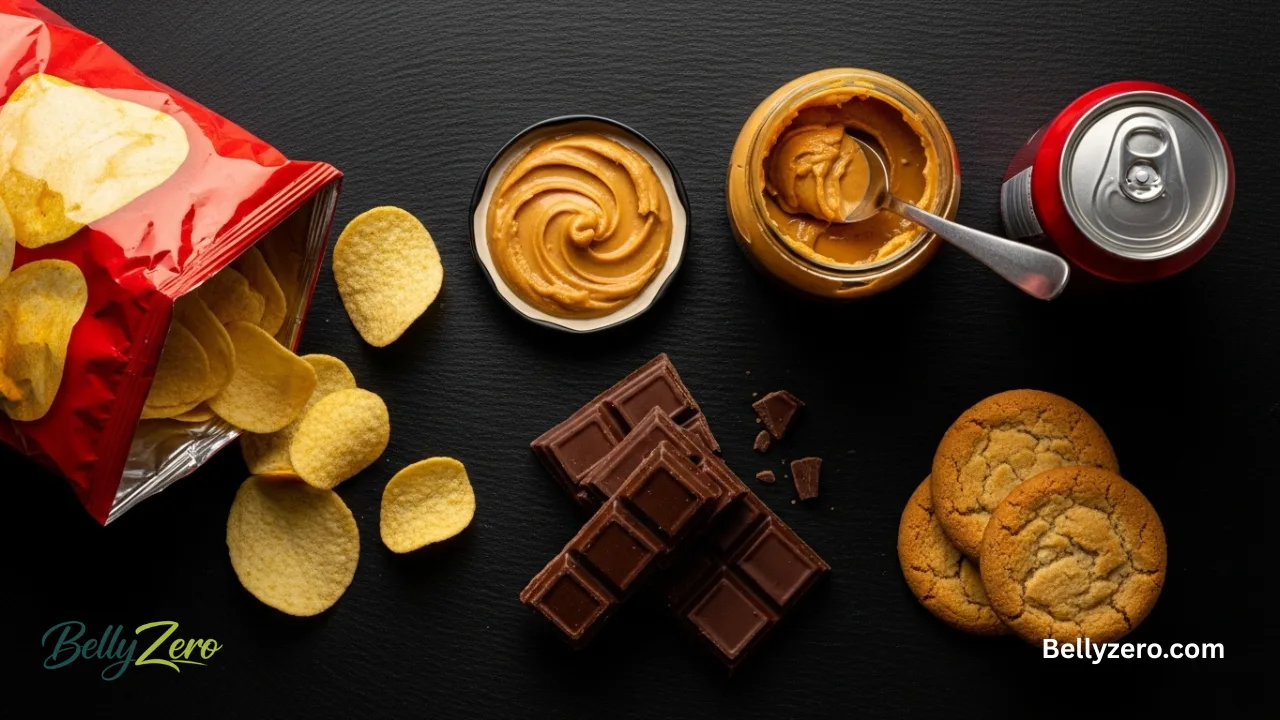
Food companies spend hundreds of millions of dollars each year researching the precise combination of salt, sugar, and fat that makes you unable to stop eating, and they refer to this as the bliss point. You experience it as finishing an entire bag of chips without fully realizing it happened or eating half a sleeve of cookies when you only intended to have one.
Understanding why these foods trigger this response in your brain is not about assigning blame or labeling yourself as having no willpower. It is about recognizing that the food was literally engineered to override your natural fullness signals, and once you understand that, you can start making choices with full awareness rather than just reacting.
| Food | Why You Overeat It | Damage Level |
|---|---|---|
| Potato chips | The combination of salt, fat, and crunch with zero protein or fiber means your brain never receives a meaningful fullness signal, which is exactly why stopping feels nearly impossible. | Critical |
| Cookies and sweet crackers | A blood sugar spike followed by a rapid crash creates a repeating hunger loop, and the small individual size creates the psychological illusion that having just one more is harmless. | Critical |
| Ice cream | The sugar and fat combination directly triggers dopamine release in the brain, while the cold temperature actually slows the fullness signals your stomach normally sends. | Critical |
| Fast food (burger and fries) | Salt, fat, and engineered flavor compounds work together to override satiety signals, and the social context of fast food environments encourages eating faster and more than intended. | High |
| Peanut butter (unportioned) | The smooth texture requires almost no chewing, which removes the resistance that normally slows eating and triggers fullness, making 500 calories disappear in under a minute. | High |
| Granola (eaten from the bag) | Marketed heavily as a health food, granola is dense, sweet, and easy to eat continuously, making it simple to consume three or four servings before registering any fullness. | High |
| Nuts (unportioned) | Nutritionally excellent, but their small physical size combined with high fat density means a seemingly small handful can represent 200 to 300 calories that pass almost unnoticed. | Medium |
| White bread and flour tortillas | These digest quickly, causing blood sugar to rise and fall within 60 to 90 minutes and creating a repeating hunger cycle that drives you back to eating sooner than you planned. | Medium |
| Flavored cafe coffee drinks | A large flavored latte or blended coffee drink can carry 400 or more calories, and because most people do not mentally register drinks as food, these calories tend to go completely uncounted. | High |
| Packaged fruit juice | It carries the health halo of real fruit but none of the fiber, delivering the same sugar load as a soda with zero satiety in return and no meaningful signal to stop drinking. | High |
The food is not your enemy. Not understanding what the food does to your body is your enemy.
What 300 Calories Actually Looks Like
This is the section that tends to change everything for people, because until you see what 300 calories looks like across different foods side by side, the concept of calorie density remains abstract.
This visual comparison is also the clearest explanation for why so many people eat clean but still fail to lose weight: they dramatically underestimate how little space high-calorie foods actually occupy.
| Food | Portion for 300 Calories | Visual Size | Fullness Duration |
|---|---|---|---|
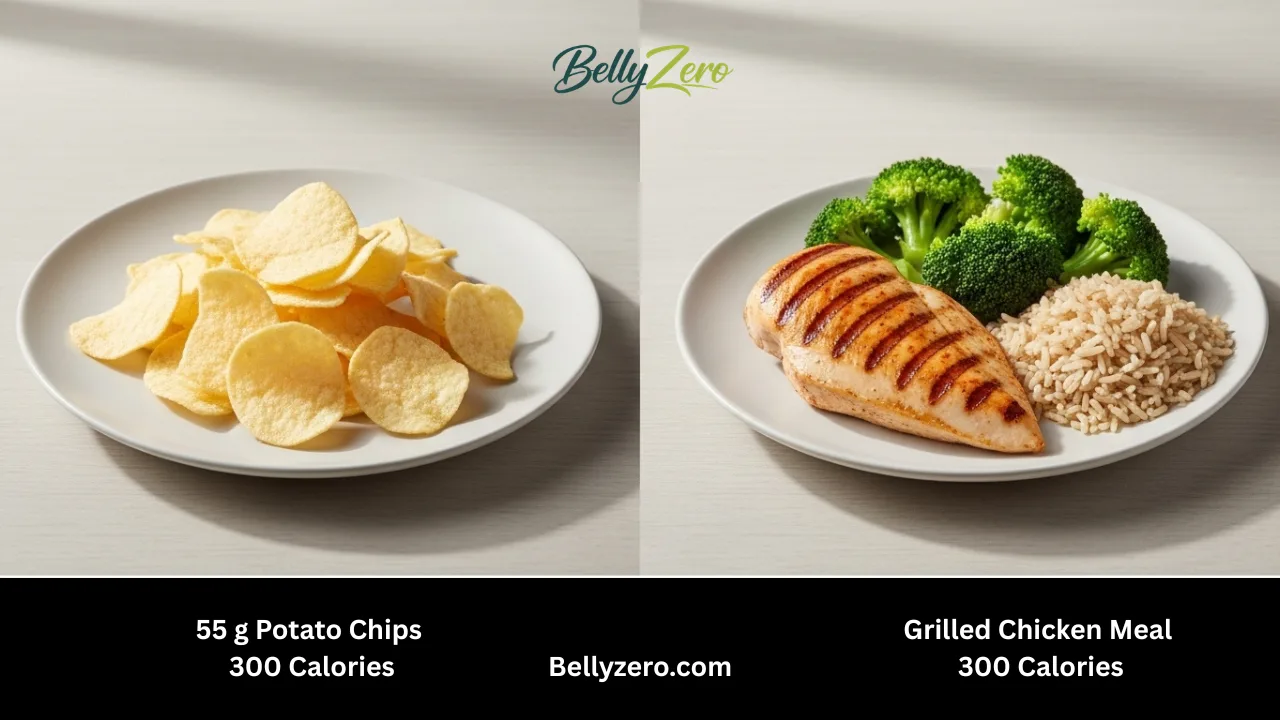
| Grilled chicken breast | About 182g, a large palm-sized piece | Large | 4 to 5 hours |
| Boiled eggs | About 4 whole eggs | Large | 4 to 5 hours |
| Cooked lentils | About 260g, which fills a large bowl | Very Large | 4 to 5 hours |
| Plain oatmeal (cooked) | About 420g, nearly two full cups | Very Large | 3 to 4 hours |
| Watermelon | About 1 kilogram, roughly 10 thick slices | Enormous | 1 to 2 hours |
| Steamed broccoli | About 880g, a genuinely massive pile | Enormous | 2 to 3 hours |
| Brown rice (cooked) | About 270g, one and a half cups cooked | Medium | 2 to 3 hours |
| White rice (cooked) | About 230g, just over one cup | Medium | 1 to 2 hours |
| Potato chips | About 55g, half a standard bag | Very Small | Under 1 hour |
| Peanut butter | About 51g, under 3 tablespoons | Tiny | 1 to 2 hours |
| Milk chocolate bar | About 56g, half of a regular bar | Very Small | Under 1 hour |
| Almonds | About 52g, roughly 37 individual almonds | Small | 1 to 2 hours |
| Olive oil | About 33g, just over 2 tablespoons | Nearly invisible | Under 1 hour |
| Fast food french fries (small) | About 96g, barely a small order | Small | Under 1 hour |
The Real Takeaway:
You could eat one kilogram of watermelon or 55 grams of chips and consume the exact same 300 calories, but one option takes ten minutes to eat and keeps you satisfied for nearly two hours while the other disappears in 90 seconds and leaves you looking for something else within half an hour.
That single comparison, held clearly in mind while you make snack decisions, is worth more than any diet plan ever written.
Protein: The Most Powerful Tool in Your Diet
If you take only one thing away from this entire guide, make it a commitment to eat significantly more protein than you currently do, because protein is the single nutrient that does more right things for fat loss simultaneously than anything else in your diet.
It suppresses hunger by affecting the hormones ghrelin and GLP-1, which regulate how hungry and how full you feel. It builds and maintains muscle tissue, which matters enormously because muscle is what keeps your metabolism high.
It burns more calories just being digested, a phenomenon called the thermic effect of food, with protein burning up to 30 percent of its own calorie content during digestion alone.
And it protects your existing muscle mass when you are in a calorie deficit, which determines whether you emerge from a diet period lean and strong or simply a smaller version of the same body composition.
Why Protein Changes Everything:
When you lose weight without adequate protein, your body begins breaking down muscle tissue for energy alongside fat, and that muscle loss slows your metabolism in a way that compounds over time.
This is the mechanism behind the “skinny fat” outcome that so many dieters experience: the number on the scale drops, but the body still looks soft because the weight lost was as much muscle as fat. Eating enough protein prevents this entirely.
How Much Protein Do You Need?
A reliable starting point is 0.8 to 1 gram of protein per pound of body weight per day, so a 150-pound person should target 120 to 150 grams daily.
If you lift weights or train regularly, pushing toward 1.2 grams per pound produces even better results for body composition.
Most people eating a standard American diet consume far less than this, often under 60 grams per day, which goes a long way toward explaining why hunger and cravings remain so persistent even when someone believes they are eating reasonably well.
A randomized controlled trial via PubMed confirmed that consuming protein above the standard recommended allowance significantly protects fat-free mass during weight loss.
Best Protein Sources for Fat Loss
Eggs remain one of the best fat loss foods available anywhere, combining high protein with healthy fat at a cost that almost anyone can sustain.
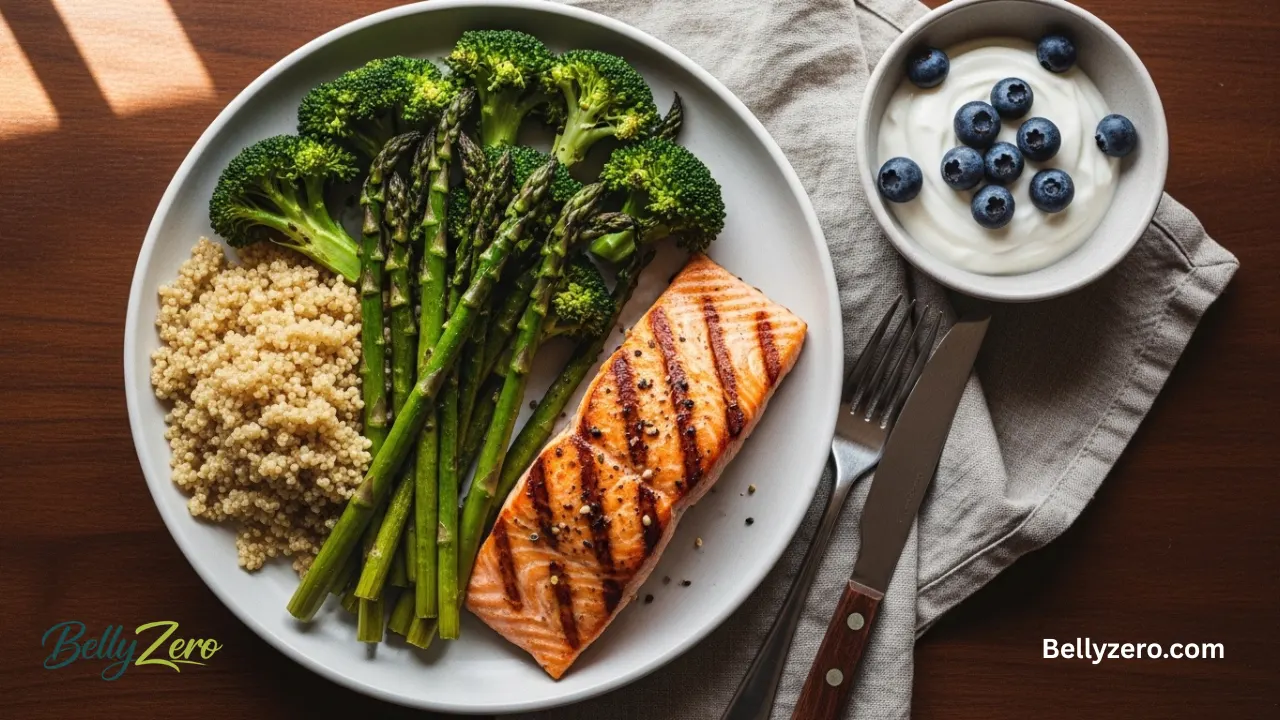
Grilled chicken breast, canned tuna, salmon, ground turkey, and shrimp are exceptional animal protein sources that fit easily into any meal structure. Greek yogurt and cottage cheese offer dense protein with minimal calories and are among the easiest snack options for hitting daily targets.
For plant-based eating, lentils, black beans, chickpeas, edamame, and tofu all deliver meaningful protein alongside the fiber that further suppresses hunger.
Most people eat less than half the protein their body actually needs. Double your protein intake and watch your hunger levels drop significantly within days.
Fiber: The Quietest Hunger Killer You Are Ignoring
Fiber does not burn fat, and it would be misleading to suggest otherwise, but what it does instead is arguably just as valuable for fat loss: it slows everything down.
Digestion slows, which means food stays in your stomach longer. Blood sugar rises more gradually after eating, which means the crash that triggers cravings comes later or barely happens at all.
And hunger takes longer to return, giving you more time between meals without the mental noise of constant appetite.
The analogy that captures this perfectly is fire. Refined carbs are kindling: they catch quickly, burn intensely, and burn out fast. Fiber is a slow log: it takes longer to ignite but keeps the fire going steadily for hours, producing consistent energy without the spikes and crashes that drive overeating.
The Fiber Effect:
Consistently eating 25 to 35 grams of fiber per day is linked to consuming fewer total calories without making any conscious effort to restrict, simply because high-fiber meals reduce how hungry you feel at the next one.
A dietary fiber and weight regulation study on PubMed found that fiber intake is inversely associated with body weight and body fat across all levels of fat intake.
There is also a gut connection that most people overlook entirely. Fiber feeds the beneficial bacteria in your gut microbiome, and a healthy microbiome reduces chronic inflammation, which plays a direct role in fat storage and cravings.
When your gut bacteria are well-nourished, your hunger hormones regulate more reliably and your cravings for processed food tend to decrease noticeably over time.
The best high-fiber foods for fat loss are whole lentils, black beans, chickpeas, oats, raspberries, pears, apples eaten with skin, broccoli, cabbage, cauliflower, and chia seeds, none of which are exotic or expensive, and most of which are already in a standard American kitchen.
One practical habit worth building immediately: start every main meal with a serving of vegetables or a small side salad before moving to the protein and carbs. This single change reduces how much of everything else you eat at that meal with no willpower required, simply because your stomach is partially full before the higher-calorie components arrive.
Eat vegetables first and eat less of everything else. That is the entire strategy, and it works every time.
Carbs Are Not the Enemy. The Wrong Carbs at the Wrong Time Are.
The anti-carbohydrate movement has caused genuine harm to millions of people’s relationship with food, convincing them to fear oats, sweet potatoes, brown rice, and beans, which happen to be some of the most effective fat loss foods in existence when eaten as part of a properly structured meal.
Your brain runs on glucose derived from carbohydrates, and your muscles store glycogen that also comes from carbohydrates. When carbs are cut completely, the immediate consequences are fatigue, mental fog, irritability, and the loss of water weight that gets confused for fat loss.
The longer-term consequence is almost always a binge, because your body will eventually demand the fuel it has been deprived of and the craving becomes impossible to override.
The actual problem has never been carbohydrates as a category. The problem is specifically processed, low-fiber carbs consumed in excess: white bread, cookies, chips, packaged juice, flavored crackers, pastries, and sugary snacks that spike blood sugar rapidly, crash it equally fast, and then pull you back for more before you have digested what you just ate.
Eating oats, quinoa, sweet potato, brown rice, lentils, and whole grain bread without guilt, paired properly with protein and vegetables, is not a cheat meal. It is a well-structured fat loss meal, and treating it as anything less is a mistake that makes the entire process harder than it needs to be.
Build Your Own Fat Loss Meal (The Formula)
The search for the perfect meal plan is one of the most common traps in fat loss, because perfection is the enemy of consistency and consistency is the only thing that actually produces results.
Instead of following a rigid plan, use this formula at every meal: it is flexible enough to accommodate any food preference, simple enough to apply in under 30 seconds, and proven enough to produce real results without requiring anything to be weighed, tracked, or obsessed over.
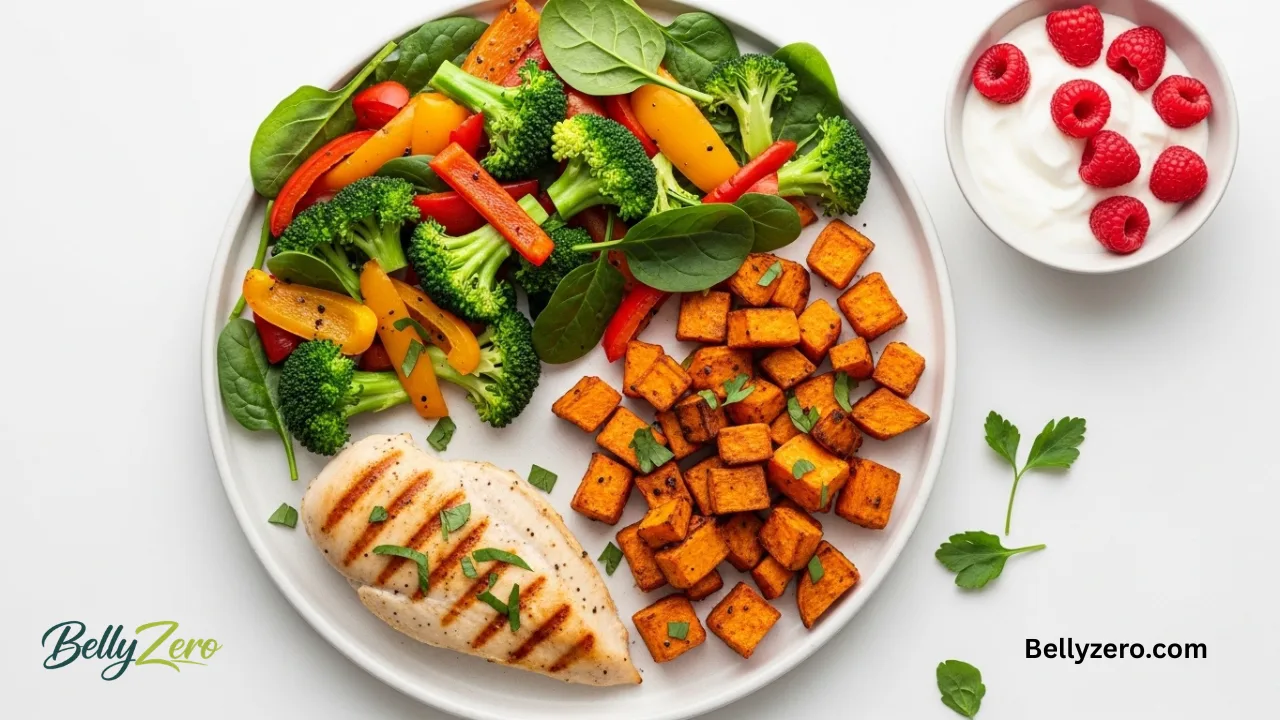
The Bellyzero Plate Formula:
Choose one item from each category below and combine them on your plate. Adjust portion sizes based on your hunger level and your daily calorie target.
Protein (40% of your plate): Eggs, grilled chicken, canned tuna, salmon, ground turkey, lentils, Greek yogurt, cottage cheese, black beans, shrimp, tofu, or any other lean protein source you enjoy.
Vegetables (30% of your plate): Spinach, broccoli, cauliflower, cucumber, bell peppers, zucchini, mixed greens, asparagus, cabbage, mushrooms, or any non-starchy vegetable that you will actually eat consistently.
Carbs (20% of your plate): Brown rice, oats, quinoa, sweet potato, whole grain bread, corn tortillas, or air-popped popcorn. Choose the option that fits the meal and keep the portion to roughly one quarter of your total plate.
Fat (10% of your plate): One teaspoon of olive oil used in cooking, a small handful of almonds, half an avocado, or two tablespoons of hummus. Fat is essential and should not be eliminated, only controlled.
Examples:
Breakfast: Two scrambled eggs with sauteed spinach and mushrooms, one slice of whole grain toast, and half an avocado on the side.
Lunch: Grilled chicken breast over a large bed of mixed greens with cucumber, cherry tomatoes, and a light olive oil dressing, with one cup of brown rice on the side.
Dinner: Baked salmon with a generous serving of roasted broccoli and asparagus alongside a medium roasted sweet potato.
Snack: Plain Greek yogurt with a handful of fresh raspberries and 10 almonds.
These are not diet meals. They are normal, satisfying, genuinely enjoyable meals that happen to be built in a way that makes fat loss almost automatic, because they are high enough in protein and fiber to keep you full until the next meal without requiring any additional willpower to get there.
Why Your Diet Is Not Working (Honest Diagnostic)
If you are consistently eating what feels like healthy food but the scale is not moving, one of the following seven reasons almost certainly explains it.
Read through each one honestly, because identifying your specific problem is the only way to fix it.
You are eating healthy foods but far too much of them.
Calories still count regardless of how clean the food source is. Five hundred grams of almonds contains nearly 3,000 calories, and even the most nutritious fat loss foods will cause weight gain when consumed in quantities that exceed your daily calorie needs. Track everything you eat for three days and remain honest about portion sizes, because most people discover they are eating significantly more than they estimated.
You are not eating enough protein.
Low protein intake leads directly to persistent hunger, which leads directly to overeating, often of the wrong foods at the worst times. Adding a single high-quality protein source to every meal is one of the highest-return changes you can make and typically produces a noticeable drop in hunger within the first week.
You are drinking a significant portion of your daily calories.
A large flavored latte, a glass of packaged juice, and a sports drink together can contribute 600 to 800 liquid calories to your day before a single solid meal has been eaten, and because drinks register differently in the brain than food, most people do not count them.
Switch to water, black coffee, sparkling water, or plain green tea and this single change eliminates a substantial hidden calorie load.
You skip meals during the day and overeat at night.
Undereating through the day leaves you genuinely desperate by evening, at which point willpower becomes irrelevant because your hunger hormones have fully taken over. Eating three structured, protein-rich meals distributed through the day keeps those hormones in check and removes the biological pressure that causes evening binges.
You are chronically undersleeping.
Sleeping fewer than six hours per night raises ghrelin, which is your primary hunger hormone, and lowers leptin, which is your primary fullness hormone, creating a chemical environment in which fat loss becomes extremely difficult regardless of how well you eat during the day. Prioritizing sleep is not optional in a serious fat loss effort: it is foundational.
NIH research on sleep deprivation and hunger hormones confirms that reduced leptin and increased ghrelin levels directly correlate with increased subjective hunger when individuals are sleep-restricted.
You restart perfectly every Monday and quit by Wednesday.
The pattern of radical restart followed by early collapse almost always comes from attempting too many changes at once. Pick a single behavior to change this week, execute it until it feels automatic, and then add one more. The compounding effect of small consistent changes over time is what produces the results that dramatic overhauls never quite manage to deliver.
You treat the weekend as a complete exemption from your goals.
Friday night through Sunday night accounts for 10 or more meals and several snacking occasions. If all of those are completely uncontrolled, you erase the calorie deficit you created during the week and end up exactly where you started every Monday.
You can absolutely enjoy weekends, including meals out, social events, and foods you love, but approaching them with awareness rather than complete abandonment makes the difference between progress and stagnation.
A Sample Fat Loss Day That Feels Like Normal Life
This is what a well-structured fat loss day actually looks like when you stop following rigid diet rules and start applying the principles in this guide. No suffering, no extreme restriction, nothing that requires you to live in a gym or carry food in containers everywhere you go.
“This is not a diet. This is normal eating done right.”
7:00 AM: Two scrambled eggs with sauteed spinach and mushrooms, one slice of whole grain toast, half an avocado, and a black coffee with no sugar. Approximately 380 calories. A high-protein start that eliminates morning hunger for several hours and removes the mid-morning urge to snack on whatever is within reach.
10:30 AM: One medium apple, 12 almonds, and a large glass of water. Approximately 170 calories. The fiber from the apple combined with the fat from the almonds keeps you comfortable and focused through to lunch without the blood sugar crash that hits people who skip this window.
1:00 PM: Grilled chicken breast over a large mixed salad with cucumber, cherry tomatoes, red onion, and a light olive oil and lemon dressing, with one cup of brown rice on the side. Approximately 550 calories. A complete and satisfying lunch that covers protein, fiber, healthy fat, and complex carbs in one meal without requiring anything complicated to prepare.
4:00 PM: Plain Greek yogurt with a handful of fresh blueberries. Approximately 130 calories. This afternoon snack is the one that prevents the evening binge, because arriving at dinner actually hungry rather than absolutely starving makes portion control almost effortless.
7:30 PM: Baked salmon with a generous side of roasted broccoli and a medium sweet potato. Approximately 480 calories. A protein-rich dinner with plenty of fiber and satisfying volume, eaten early enough that your body has time to digest before sleep.
Daily total: approximately 1,710 calories, which creates a comfortable deficit of 300 to 500 calories for most adults and translates to roughly half a pound to one pound of fat loss per week at a pace that is genuinely sustainable over months rather than days.
Common Myths About Weight Loss Foods
MYTH 1: Eating after 8 PM causes weight gain.
Your body does not operate on a clock that switches into fat storage mode at a specific hour. What actually matters is the total number of calories you consume across the entire day, regardless of when they arrive.
The reason late-night eating becomes problematic for most people is behavioral: nighttime is when cravings peak, portion control weakens, and the foods chosen are rarely the ones on the satiety-score chart.
Fix the habit of reaching for food late at night and the timing of your earlier meals becomes irrelevant.
MYTH 2: Green tea burns fat.
Green tea contains caffeine and catechins that produce a mild thermogenic effect, but the actual calorie impact of this in practice amounts to roughly 60 to 80 additional calories burned per day. That is approximately the calorie content of one tablespoon of peanut butter, which is not a meaningful fat loss mechanism by any measure.
Green tea is a genuinely healthy beverage and an excellent replacement for sugary drinks, but marketing it as a fat burner is a significant exaggeration of its actual effects.
MYTH 3: Carbs make you fat.
Cooked brown rice contains about 111 calories per 100 grams, oats contain 71, and lentils contain around 116. These foods are dietary staples for populations around the world with significantly lower obesity rates than the United States.
Carbohydrates as a category do not cause fat gain: consuming more total calories than you burn does. The conflation of refined, processed carbs with whole food carbohydrate sources has created an irrational fear of some of the most effective fat loss foods available.
MYTH 4: Dietary fat makes you fat.
Eating fat does not cause your body to automatically store fat. Every macronutrient consumed in excess of your calorie needs gets stored as body fat, including protein and carbohydrates.
Healthy fats from avocados, nuts, olive oil, and fatty fish are essential for hormone production, brain function, and fat-soluble vitamin absorption, and eliminating them from your diet in the name of fat loss creates hormonal and nutritional problems that work against your goals.
MYTH 5: You need a detox or cleanse to lose weight.
Your liver processes toxins continuously, your kidneys filter your blood around the clock, and your gut microbiome manages waste elimination with a level of efficiency no commercial cleanse product comes close to replicating.
Detox teas and juice cleanses are largely expensive laxatives that produce water loss, not fat loss. If you want to support your body’s natural detoxification processes, drink more water, eat more fiber, sleep more, and reduce processed food intake. That is the entire protocol.
Why This Approach Works and Why Every Other Diet You Have Tried Did Not
Most diets fail not because the people following them lack discipline or commitment, but because the diets themselves are designed in a way that fights human biology rather than working with it.
They impose restriction, restriction generates hunger, hunger generates cortisol and ghrelin, those hormones override every rational intention you have, and the result is an inevitable binge followed by guilt followed by another Monday restart. The diet failed. You did not.
This approach works differently because it is built around the mechanism that actually governs human eating behavior: hunger. By building meals around high-protein, high-fiber foods that score 7 or higher on the satiety scale, you naturally reduce your total calorie intake without relying on willpower to sustain a deficit.
Your body receives adequate protein, adequate fiber, adequate volume, and adequate micronutrients, which means it does not enter the hormonal alarm state that makes every other diet ultimately collapse.
The research on satiety is unambiguous: high-protein, high-fiber meals reduce total calorie intake for the remainder of the day compared to calorie-matched meals that are low in protein and fiber. The calories at lunch are the same, but what happens between lunch and dinner is completely different, because one meal leaves you genuinely satisfied and the other leaves you hunting for something more within the hour.
The best foods for weight loss are not magic, and they do not burn fat independently of a calorie deficit.
What they do is make the basic physics of fat loss, consuming fewer calories than you burn, dramatically easier to sustain over the weeks and months that lasting body transformation actually requires.
Sustainable fat loss is not primarily about discipline. It is about designing your meals so that discipline is barely necessary.
What To Do Right Now. Not Tomorrow.
You now have the complete system: a 100-plus food database with satiety scores, a plate formula you can apply immediately, a visual breakdown of calorie density that changes how you see snacks, and a diagnostic checklist that identifies exactly where your previous attempts broke down.
The only remaining variable is action, and the best action is always the smallest one that you can execute today without needing to overhaul your entire routine.
STEP 1: Add one protein source to your very next meal. Eggs, Greek yogurt, a chicken breast, cottage cheese, canned tuna, or a cup of lentils. One addition, starting now.
STEP 2: Replace one snack today with a high-satiety alternative. Chips become apple and almonds. A flavored coffee drink becomes black coffee or sparkling water. One swap, one decision.
STEP 3: At your next meal, eat the vegetables or salad first before touching the protein and carbs. One habit, no willpower needed, immediate impact on how much you eat of everything that follows.
Fat loss is not a single dramatic event. It is the accumulated result of small, consistent decisions made across hundreds of meals over weeks and months, and the person who makes slightly better choices slightly more often is the person who wins.
You now have better information and a clearer system than the vast majority of people attempting fat loss right now. The next step is simply to begin.
Frequently Asked Questions
The practical rule is straightforward: build every meal around a protein source, fill at least a third of your plate with vegetables, add a moderate portion of a whole food carb, and keep added fat minimal. That structure naturally keeps calories in check without requiring constant tracking.
The easiest way to hit your protein target is to include a source at every single meal. Eggs or Greek yogurt at breakfast, chicken, tuna, or cottage cheese at lunch, and salmon, ground turkey, or lentils at dinner gets most people to their daily target before they even think about snacks.
The practical approach is not to count every gram but to eliminate the highest-damage foods first. Cutting sugary drinks alone removes 300 to 600 hidden daily calories for most people. Replacing packaged snacks with whole food options like an apple with almonds or plain Greek yogurt with berries makes the next biggest impact without requiring a complete diet overhaul.
The most effective approach is to treat food choices as the primary fat loss driver and use exercise to preserve muscle, improve metabolic health, and speed up results. Trying to out-exercise a poor diet is one of the most common mistakes in weight loss, and the research consistently shows that dietary change produces faster fat loss results than exercise change alone.
The same logic applies to bread. Two slices of whole grain bread with eggs and avocado is a well-structured fat loss meal. Two slices of white bread with butter and jam is a blood sugar spike that triggers cravings within the hour. The bread is not the problem. The full context of the meal determines the result.
The worst breakfast choices for weight loss are those high in sugar and low in protein: sugary cereals, flavored yogurt, pastries, bagels with cream cheese, and most commercial granola products. These create a blood sugar spike followed by a crash within 90 minutes, triggering hunger and cravings well before lunchtime and making the rest of the day significantly harder to manage.
Sleep is the most overlooked factor in this situation. Less than six hours per night raises ghrelin significantly and lowers leptin, creating a hormonal environment that drives overeating regardless of how disciplined food choices are during the day. Improving sleep alone has produced measurable fat loss in controlled studies without any dietary changes, which shows just how powerful this variable actually is.
Oatmeal is another standout because beta-glucan, the soluble fiber it contains, forms a gel in the stomach that slows digestion and keeps hunger hormones suppressed for hours. Eggs work through a different mechanism: high protein content triggers peptide YY, a fullness hormone, that signals the brain to stop eating well before the meal is over. Using these foods as the foundation of daily meals is the simplest way to eat less without feeling deprived.
The practical approach is to think of it as a high-calorie meal rather than a cheat meal. Cheat implies guilt and an all-or-nothing mindset that often leads to a full weekend of overeating. A planned high-calorie meal that you enjoy and then move on from is a sustainable part of any long-term fat loss approach, and research shows that planned dietary flexibility improves adherence and total fat loss outcomes compared to rigid restriction.
For informational and educational purposes only. All content on BellyZero, including articles, calculators, health tools, templates, and recipes, is intended to provide general health information. It does not constitute medical advice, a clinical diagnosis, or a substitute for professional healthcare guidance.
Results generated by BellyZero calculators and tools are estimates based on population-level formulas and standard reference ranges. They do not account for your full medical history, individual physiology, existing health conditions, or medications. Results may not apply to pregnant women, children, competitive athletes, or individuals with chronic illness.
Always consult a qualified healthcare professional before making changes to your diet, exercise routine, or health regimen based on anything found on this website. If you have symptoms or concerns about your health, seek medical attention promptly. BellyZero does not accept liability for decisions made based on content published on this site.