
Water Intake Calculator: How Much Water Do You Actually Need Each Day?
This free Water Intake Calculator gives you a personalized daily hydration target based on your body weight, activity level, daily steps, climate, and goal. Choose from three modes: General Health, Fat Loss, and Gym Performance. Includes creatine water scaling by phase and body weight, electrolyte estimates, urine color guide, bottle visualizer, and a full daily drinking schedule. Built on EFSA, ACSM, and ISSN peer-reviewed science.
Select your goal below, fill in your details, and hit Calculate to get your personalized hydration target instantly.
Calculate to see your personalized results.
Spread intake throughout the day. Avoid more than 800-1,000 ml per hour. Reduce intake 90 min before bed.
📚 Scientific references
- EFSA Panel on Dietetic Products (2010). Scientific Opinion on Dietary Reference Values for water. EFSA Journal 8(3):1459.
- Sawka MN et al. (2007). ACSM Position Stand: Exercise and Fluid Replacement. Med Sci Sports Exerc 39(2):377-390.
- Kreider RB et al. (2017). ISSN Position Stand: Safety and Efficacy of Creatine Supplementation. JISSN 14:18.
- Hew-Butler T et al. (2015). 3rd International EAH Consensus. Clin J Sport Med 25(4):303-320.
- Dennis EA et al. (2010). Water consumption increases weight loss during a hypocaloric diet intervention. Obesity 18(2):300-307.
- Killer SC et al. (2014). No Evidence of Dehydration with Moderate Daily Coffee Intake. PLOS ONE.
- Polhuis KCMM et al. (2017). The Diuretic Action of Weak and Strong Alcoholic Beverages. Nutrients 9(7):660.
How Much Water Should You Drink a Day? (The Real Answer, With the Science)
You have probably heard the 8 glasses a day rule your entire life. Here is the truth about where that came from: a 1945 nutrition recommendation that was never backed by a clinical trial. A professor named Fredrick Stare pushed it into popular culture decades later, and it stuck. Not because it was accurate but because it was easy to remember.
Your actual daily water need is not the same as your neighbor’s. It depends on your weight, how hard you train, where you live, what supplements you take, and whether you are pregnant or breastfeeding. A 120-pound woman at a desk job in Seattle needs a very different amount than a 200-pound man doing HIIT workouts in Phoenix.
That is what the calculator on this page solves. Enter your details and you get a number built around your body and your goals. Not a population average from 80 years ago.
This guide explains every factor behind the calculation, answers the hydration questions people search most, and gives you the science behind why your result is what it is.
What the Research Says About Daily Water Needs
The two most trusted sources for hydration guidelines are the European Food Safety Authority (EFSA) and the National Academies of Sciences, Engineering, and Medicine (NASEM) in the United States.
EFSA sets the daily reference intake at 2.0 liters for women and 2.5 liters for men in temperate climates with moderate activity.
NASEM puts the total adequate intake, including water from food, at 3.7 liters for men and 2.7 liters for women. Since roughly 20% of daily fluid intake comes from food, the pure beverage target works out to about 3.0 liters for men and 2.2 liters for women.
Neither of those is 8 glasses. And neither accounts for your specific situation.
The calculator on this page starts with the higher of two baselines:
- The EFSA sex-specific reference value
- 35 ml per kilogram of body weight, a widely used clinical starting point
From there, it adds exercise sweat loss based on ACSM position stands, non-exercise activity, protein intake adjustments, creatine-specific demand, climate modifiers, and special conditions like pregnancy or fever. The result is a personalized number, not a population ballpark.
The 6 Factors That Change How Much Water You Need
Body Weight
Bigger bodies need more water. Muscle tissue holds significantly more water than fat tissue, roughly 75% water versus about 10%. This is the basis for the 35 ml per kilogram formula. A 60 kg person needs about 2,100 ml from that formula alone. An 85 kg person needs about 2,975 ml.
Body weight is the single strongest predictor of baseline fluid need, which is why every solid water intake calculator by weight starts here.
Activity Level and Exercise
The American College of Sports Medicine estimates sweat loss by training intensity:
| Activity Level | Estimated Sweat Loss | Extra Water Needed |
|---|---|---|
| Sedentary (desk job, minimal movement) | Negligible | 0 ml |
| Light activity (yoga, walking) | 150 to 200 ml per session | +150 ml |
| Moderate (gym 3 to 5x per week, 30 to 60 min) | 375 to 500 ml per session | +375 ml |
| Very active (daily intense training, HIIT, 60+ min) | 750 to 1,000 ml per session | +750 ml |
Source: ACSM Position Stand on Exercise and Fluid Replacement, Sawka et al. 2007 [3]
A 2% drop in body fluid causes a measurable decline in aerobic performance. At 4%, strength output falls noticeably. Thirst kicks in at around 1 to 2% deficit, so by the time you feel thirsty during a workout, you are already behind.
Daily Steps and Non-Exercise Activity
Exercise is not the only way your body loses water. Walking to meetings, running errands, and doing housework all produce sweat, even when you cannot feel it. Researchers call this NEAT: non-exercise activity thermogenesis.
The calculator adds a NEAT adjustment based on your step count each day:
| Daily Steps | Extra Fluid Needed |
|---|---|
| Under 5,000 | +0 ml |
| 5,000 to 10,000 | +150 ml |
| 10,000 to 15,000 | +300 ml |
| 15,000+ | +500 ml |
Climate and Heat
Heat is one of the most underestimated factors in daily hydration. When air temperature rises above 25°C (77°F), your body ramps up sweating to cool itself. In very hot or humid conditions above 32°C (90°F), that process becomes much more aggressive.
The calculator applies climate multipliers based on ACSM guidance:
- Temperate (below 25°C): Baseline, no adjustment
- Hot (25 to 32°C): +12.5% added to your total target
- Very hot or humid (above 32°C): +22.5% added to your total target
One safety point for hot weather training: never drink more than 800 to 1,000 ml of plain water per hour during sustained activity. Drinking too much plain water in the heat can dilute blood sodium and cause hyponatremia, a dangerous condition that has killed endurance athletes. Use an electrolyte drink for sessions longer than 60 minutes in hot conditions.
Age
Adults under 18 have slightly lower fluid requirements per kilogram of body weight. Adults over 65 need slightly more because the kidneys’ ability to concentrate urine declines with age and the thirst sensation becomes less reliable as a warning signal. The calculator applies a +5% age modifier for adults 65 and older and a -5% modifier for those under 18.
Special Conditions
Several physiological states significantly increase how much water you need each day:
- Pregnancy: EFSA recommends an additional 300 ml per day to support amniotic fluid volume and fetal circulation.
- Breastfeeding: EFSA recommends +700 ml per day for lactating women
- Fever: Each degree Celsius above 37°C (98.6°F) increases water loss by approximately 150 ml per day.
- Illness with vomiting or diarrhea: Significant fluid losses that require active replacement on top of your baseline target
Water Intake by Weight: A Quick Reference Chart
If you want a fast estimate before using the calculator, the 35 ml per kilogram benchmark gives you a solid sedentary baseline. Add sweat loss and climate adjustments from there.
| Body Weight | Sedentary Baseline | With Moderate Exercise | With Hot Climate Added |
|---|---|---|---|
| 50 kg / 110 lb | 1.75 L | 2.13 L | 2.39 L |
| 60 kg / 132 lb | 2.10 L | 2.48 L | 2.79 L |
| 70 kg / 154 lb | 2.45 L | 2.83 L | 3.18 L |
| 80 kg / 176 lb | 2.80 L | 3.18 L | 3.58 L |
| 90 kg / 198 lb | 3.15 L | 3.53 L | 3.97 L |
| 100 kg / 220 lb | 3.50 L | 3.88 L | 4.36 L |
These are estimates for healthy adults in good health. The calculator above gives you a more precise figure based on your specific inputs.
Does Coffee Count as Water Intake?
Yes, with one important limit you need to know.
Coffee is roughly 98% water. When you drink a cup of black coffee, nearly all of that liquid counts toward your daily fluid total. The concern about coffee being dehydrating comes from caffeine’s mild diuretic effect, which makes you urinate a bit more. But that effect is mild.
A study published in PLOS ONE in 2014 found that coffee drinkers who consumed up to 4 cups per day (about 400 mg of caffeine) showed no meaningful difference in hydration markers compared to people who drank only water. Your body adapts to regular caffeine intake and reduces the diuretic response over time.
The practical rule: at or below 400 mg of caffeine per day, coffee counts toward your daily fluid total. Above that, the diuretic effect becomes strong enough that you start losing a meaningful net amount of fluid.
A few things worth knowing:
- A standard 8 oz brewed coffee gives you roughly 6.8 oz of net hydration, accounting for about 15% fluid loss at moderate caffeine intake.
- Espresso shots are so small in volume that their hydration contribution is minimal no matter how you look at it.
- Sugary coffee drinks add calories without meaningfully improving hydration.
- If you are not a regular coffee drinker, the diuretic effect hits harder. Give your body 2 to 3 weeks to adapt before counting coffee as a full fluid source.
- Decaf coffee has nearly the same hydrating effect as water because the diuretic mechanism is caffeine-driven, not coffee-driven.
The short answer: 1 to 4 cups of coffee per day counts toward your fluid goal. Coffee is not a replacement for water, but it is not working against you at moderate intake either.
Does Tea Count Toward Water Intake?
Yes, and tea generally counts more reliably than coffee does.
Most teas, including green tea, black tea, and herbal teas, contain less caffeine than coffee. A standard cup of black tea carries 40 to 70 mg of caffeine versus 80 to 100 mg in a typical brewed coffee. Green tea runs even lower at 20 to 45 mg per cup.
Because the diuretic effect is directly tied to caffeine dose, tea tends to produce a smaller urination response than coffee. That makes it a slightly more efficient fluid source per cup.
Herbal teas such as chamomile, peppermint, and rooibos contain zero caffeine and hydrate just like plain water.
Some research suggests green tea catechins modestly support fat metabolism. But the hydration benefit is simple regardless of that secondary effect. You are putting fluid into your body.
One thing to watch: do not add a lot of sugar. Sugar does not cancel out hydration, but excess dietary sugar can pull water out of cells over time through osmotic effects, which complicates your fluid balance.
Does Sparkling Water Count as Water Intake?
Yes, fully.
Sparkling water, whether plain carbonated water, club soda, or unsweetened sparkling mineral water, hydrates you just as well as still water. A study published in the American Journal of Clinical Nutrition found no difference in hydration status between still and sparkling water drinkers.
The carbonic acid in sparkling water is CO2 dissolved in water. It is mild, temporary, and does not meaningfully alter blood pH or prevent fluid absorption in the gut.
Here is what to check on the label:
- Plain sparkling water or club soda: Counts fully toward your daily target
- Flavored sparkling water with no sweetener: Counts fully. Artificial or natural flavors do not affect hydration
- Tonic water: Contains added sugar and often high-fructose corn syrup. Treat it more like a soda than a hydration source
- Sparkling water with juice or sweeteners: The fluid content is real, but the sugar content is a separate consideration
If you drink flavored sparkling water as a substitute for soda, that is a smart move. The hydration math is the same as plain water.
Does Beer Count as Water Intake?
Beer works differently from coffee and tea, and the answer depends more on alcohol content than most people expect.
A 12 oz regular beer runs about 90% water by volume, but alcohol is a diuretic. It suppresses antidiuretic hormone (ADH), the hormone that tells your kidneys to hold onto water. When ADH drops, your kidneys flush out more fluid than they normally would.
The research on this is more specific than most people know. A randomized controlled trial published in Nutrients in 2017 put beer, wine, and spirits head-to-head against their non-alcoholic equivalents over 24 hours. Regular beer at 5% ABV produced no significant difference in total urine output compared to non-alcoholic beer across the full day. Wine and spirits, carrying higher alcohol concentrations, drove a meaningfully larger urine output.
Here is what that means for you in practice. One regular beer with a meal will not push most healthy adults into a fluid deficit. But beer still delivers zero hydration benefit that water would not give you better, and several drinks in a sitting, particularly wine or spirits, will pull your fluid balance into the negative. More alcohol in the glass means a stronger diuretic hit.
The practical rule: do not count alcoholic drinks toward your daily water target. Drink one extra glass of water per alcoholic drink to keep your fluid balance steady.
Light beer at 3 to 4% ABV triggers less ADH suppression than regular beer and far less than wine or spirits. One or two servings will not move your fluid balance much, but light beer still adds nothing a glass of water would not do more effectively.
Non-alcoholic beer at 0.5% ABV or less counts toward your daily fluid total the same way water does. That alcohol level sits too low to trigger any real ADH suppression.
Water Intake for Weight Loss: Does Drinking More Water Help?
Water can support fat loss in three documented ways. None of them involve magic.
Pre-meal volume lowers calorie intake
A randomized controlled trial published in Obesity followed overweight adults for 12 weeks. The group that drank 500 ml of water 30 minutes before each meal lost significantly more weight than the control group, an average of 2 kg more over the study period. Water occupies stomach volume and activates stretch receptors that signal fullness before you start eating.
Thermogenic effect (small but consistent)
One study published in the Journal of Clinical Endocrinology and Metabolism in 2003 found that drinking 500 ml of water at room temperature raised metabolic rate by approximately 30% for about 60 minutes, with a total energy cost of roughly 100 kJ (about 24 kcal) per 500 ml.
A follow-up study in 2006 by a separate research group could not replicate this result and raised questions about the measurement method used. The thermogenic effect of plain water remains a real possibility but not a settled fact. Treat it as a potential bonus of hitting your daily target, not a reliable weight loss strategy on its own.
Dehydration reads like hunger
Your hypothalamus handles both hunger and thirst signals, and these systems can cross-activate. Mild dehydration often produces a sensation that people interpret as hunger, which leads to eating when drinking would have been the right response. Staying well-hydrated removes that false signal.
Does drinking water alone cause weight loss? No. Water does not burn fat directly. It supports the conditions: appetite control, metabolic efficiency, and kidney function, that help your other healthy habits work better.
The weight loss mode in the calculator above applies a BMI-based upward modifier to account for higher body mass and the increased metabolic demand that comes with it. It also includes pre-meal hydration as a behavioral recommendation in your results.
Creatine and Water Intake: What the Science Actually Says
Creatine gets more questions about hydration than almost any other supplement. Most of those questions come from confusion about what creatine actually does inside your body. Here is the full picture, sourced from peer-reviewed research.
What Creatine Does to Water in Your Body
Creatine is a naturally occurring compound your body builds from three amino acids: arginine, glycine, and methionine. Your liver, kidneys, and pancreas produce it, and you absorb more from meat and fish in your diet.
Here is where water becomes relevant: creatine is osmotically active. It attracts and holds water molecules. More specifically, it draws water into muscle cells through sodium-based transporters. This is not a side effect you need to manage. It is the core mechanism behind several of creatine’s performance benefits.
When water moves into your muscle cells, several things happen:
- Muscle fibers swell slightly, creating what researchers call cellular volumization
- The phosphocreatine system regenerates ATP, your muscles’ energy currency, faster during high-intensity effort
- Creatine loading alongside carbohydrate intake promotes greater glycogen restoration, which supports recovery between sessions
- Muscles look fuller and feel harder, especially during the first two weeks of supplementation
The 1 to 3 lb weight gain people commonly see in the first week of creatine use comes almost entirely from this process. That weight is not fat. It is water inside muscle cells doing exactly what it is supposed to do.
Intracellular vs. Extracellular Water: Clearing Up the Bloating Fear
The most common concern about creatine is that it causes bloating or a puffy, swollen look. This fear comes from a misunderstanding of where the water actually ends up.
Two fluid compartments matter here:
Intracellular water sits inside your muscle cells. This is where creatine moves water. It makes muscles look fuller and more dense. Multiple controlled studies measuring fluid distribution consistently show that creatine increases intracellular volume without significantly changing extracellular volume.
Extracellular water sits outside cells, between tissues and under the skin. This type of water retention causes the puffy, soft look people worry about. Creatine does not primarily drive this.
A 2025 review published in Frontiers in Nutrition examined the current body of evidence on creatine safety concerns. The authors concluded that claims linking creatine to dehydration or harmful fluid retention are “largely unsupported by controlled studies.”
Here is something counterintuitive: when you do not drink enough water while on creatine, your body responds by holding fluid extracellularly as a reserve. That is what produces visible puffiness. Drinking more water reduces it.
How Much Water to Drink With Creatine: Phase-by-Phase
Your water needs during creatine use change depending on which phase you are in.
| Creatine Phase | Daily Dose | Extra Water Needed | Total Daily Target |
|---|---|---|---|
| Loading Phase (Days 1 to 7) | 20 g/day split into 4 doses of 5g | +1,000 to 1,500 ml | 4 to 5 L based on body weight |
| Maintenance Phase (ongoing) | 3 to 5 g/day | +300 to 500 ml | 3 to 4 L based on body weight |
| No creatine supplementation | 0 g | 0 ml | 2 to 3 L based on activity level |
Ranges assume moderate activity in a temperate climate. Your actual number will differ based on weight, training intensity, and where you live.
The calculator on this page scales the creatine water addition by your exact body weight. Smaller individuals under 70 kg get a smaller addition. Heavier individuals over 90 kg get a larger one.
Creatine Water Needs Scaled by Body Weight
| Body Weight | Maintenance Extra | Loading Extra | Minimum Total (Moderate Activity) |
|---|---|---|---|
| Under 70 kg | +200 ml | +500 ml | 3.0 to 3.5 L |
| 70 to 90 kg | +300 ml | +750 ml | 3.5 to 4.0 L |
| Over 90 kg | +400 ml | +1,000 ml | 4.0 to 5.0 L |
4 Creatine and Water Myths, Cleared Up With Research
Myth 1: Creatine dehydrates you.
False. Creatine moves water into muscle cells. Systemic dehydration happens when you do not drink enough total water while creatine pulls fluid into muscles. The supplement itself does not cause it. A 2020 study found that up to 5 g of creatine daily for 35 days produced no adverse effect on kidney function or any hydration markers. A 2025 review in Frontiers in Nutrition confirmed that dehydration claims are not supported by controlled trial data.
Myth 2: You need to drink a gallon of water every day when taking creatine.
Partially true, but only during the loading phase. During loading at 20 g per day, a gallon (about 3.8 L) is a reasonable floor for active individuals above 80 kg. During maintenance at 3 to 5 g per day, the extra water need drops to just 200 to 400 ml per day. A blanket “drink a gallon” rule ignores body weight, activity level, and which phase of supplementation you are in.
Myth 3: Creatine HCl requires less water than creatine monohydrate.
False. Creatine HCl dissolves more easily in water, which can reduce stomach discomfort for some users. But the osmotic mechanism that draws water into muscle cells is the same across all creatine forms. Your total daily water need does not change based on which form you choose. Head-to-head studies have found no performance advantage of HCl over monohydrate at equivalent doses.
Myth 4: The water weight from creatine makes you look soft and puffy.
Mostly false. As explained above, creatine drives intracellular water retention inside muscle fibers, not extracellular retention under the skin. The result is fuller-looking muscles, not a soft or swollen appearance. When someone does look puffy on creatine, insufficient water intake or a high-sodium diet is a much more likely cause.
What Happens When You Do Not Drink Enough Water on Creatine
Skipping your water target while supplementing with creatine creates a specific set of problems that go beyond just feeling thirsty.
Muscle cramps: Creatine pulls fluid into muscle cells. When total body water is low, the fluid remaining outside those cells becomes depleted in electrolytes like sodium, potassium, and magnesium. That imbalance triggers cramping, especially during workouts.
Stomach discomfort and bloating: Creatine powder needs fluid to dissolve properly. Without enough water, undissolved creatine can sit in the stomach or intestines and cause nausea, bloating, and cramping. This problem is more common during the loading phase when doses are higher.
Reduced performance gains: The volumizing effect that creatine provides, the intracellular swelling that activates protein synthesis and buffers ATP, requires water to function. Dehydration limits the very mechanism you are supplementing to get.
Visible water retention (the counterintuitive one): When total body water is low, your body holds fluid extracellularly as a reserve. That produces the puffy, soft look people often blame on creatine. Drinking more water resolves it.
Higher kidney filtration load: Creatinine, the metabolic byproduct of creatine use, needs adequate fluid to be filtered and excreted efficiently by the kidneys. Consistent underhydration adds unnecessary stress to that process.
Daily Hydration Protocol for Creatine Users
Maintenance phase (3 to 5 g per day):
- Wake-up: 400 to 500 ml of water before coffee or food
- With your creatine dose: at least 250 to 375 ml of water
- 30 minutes before training: 400 ml
- During training: 150 to 200 ml every 15 to 20 minutes
- After training: Replace 150% of your estimated sweat loss over 2 to 4 hours
- Rest of the day: spread your remaining target across meals and breaks
Loading phase (20 g per day, split into 4 doses):
- Each 5 g dose needs at least 375 ml of water for proper dissolution and absorption
- Four doses means 1,500 ml from creatine dosing alone across the day
- Total daily target during loading: use the calculator above for your weight-adjusted number
- Spread doses at morning, midday, afternoon, and evening. Never take them all at once
- If stomach sensitivity is a problem, skip the loading phase. You reach the same muscle saturation at 3 to 5 g per day; it just takes 3 to 4 weeks instead of 7 days
Does the Form of Creatine Change Your Water Needs?
| Creatine Form | Solubility | Changes Water Needs? | Key Notes |
|---|---|---|---|
| Creatine Monohydrate | Moderate | No. This is the reference standard | Most studied form. Gold standard for results and safety |
| Micronized Monohydrate | Higher | No | Smaller particles, easier to mix. Same mechanism as monohydrate |
| Creatine HCl | Very high | No. Same osmotic mechanism | Marketing claims about needing less water are not backed by research |
| Creatine Ethyl Ester | High | No | Performs worse than monohydrate in head-to-head trials |
How to Know if You Are Actually Hydrated
The calculator gives you a daily target. But how do you know in real life whether you are hitting it? Three practical methods work better than counting cups.
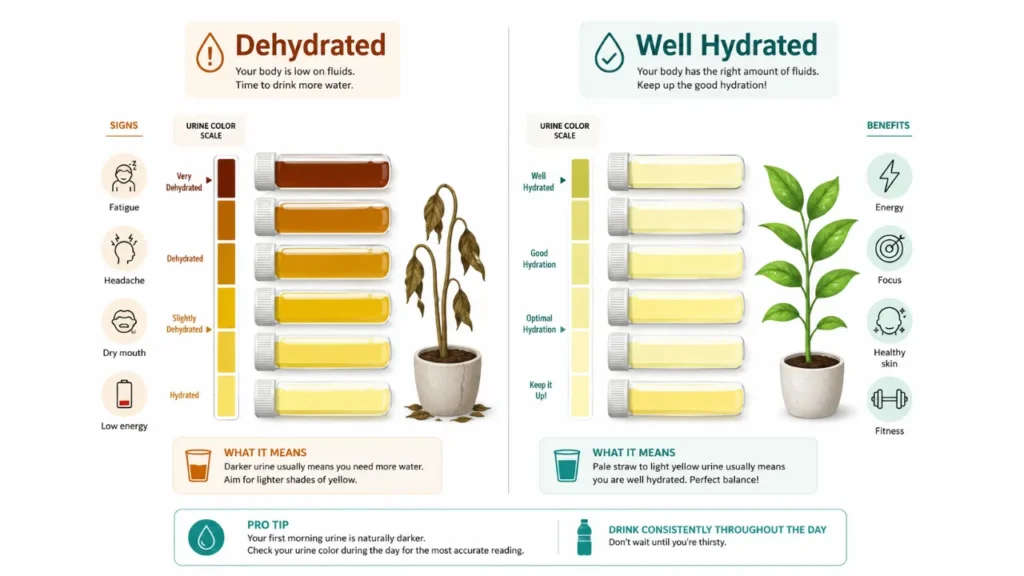
Urine Color
Your most accessible daily check. Aim for pale straw yellow, the color of light lemonade. That shade tells you your kidneys are clearing waste efficiently without concentrating urine from a fluid shortage.
- Colorless: You may be slightly over-hydrating or had a lot of fluid at once. Not dangerous for most people but not the goal
- Pale straw to light yellow: Well hydrated. Stay on track
- Dark yellow to amber: Drink water in the next 30 minutes
- Brown or orange: You are significantly dehydrated. This warrants a conversation with a doctor if it happens consistently
Your first morning void is always darker because your body concentrates urine overnight. Use your midday check as the most reliable daily hydration indicator.
Urination Frequency
Well-hydrated adults typically urinate 6 to 8 times per day. Fewer than 4 times in 24 hours suggests your fluid intake is too low. More than 10 times may point to over-hydration or a condition worth discussing with a healthcare provider.
Skin Turgor Test
Pinch the skin on the back of your hand, hold for 2 seconds, and release. In someone well-hydrated, skin springs back within 1 to 2 seconds. A slower return, called poor skin turgor, can indicate significant dehydration. This test is less reliable in older adults, but it gives a quick directional signal.
When to Drink: A Smarter Schedule
Thirst is a lagging signal. By the time you feel thirsty, your fluid balance has already dipped. A proactive daily schedule produces better results.
A practical daily hydration schedule:
6:00 to 7:00 AM (Wake-up): 400 to 500 ml right after you get up. You lose fluid overnight through breathing and minor sweating even when you cannot feel it.
With breakfast: 200 to 250 ml with your morning meal.
Mid-morning: 200 to 300 ml before 10:00 AM.
Lunch: 300 to 400 ml before or with your midday meal.
Afternoon (2:00 to 4:00 PM): The most commonly missed window. 200 to 300 ml during the typical afternoon energy dip. Dehydration is often what causes that dip.
Pre-workout (30 min before): 400 ml.
During workout: 150 to 200 ml every 15 to 20 minutes of active effort.
Post-workout: 500 to 750 ml spread over the next 2 hours. Not all at once.
Dinner: 200 to 300 ml with your evening meal.
90 minutes before bed: Your last meaningful drink of the day. Drinking closer to sleep increases nighttime urination without improving hydration.
One safety note: Do not drink more than 800 to 1,000 ml of plain water per hour during exercise. Exceeding that rate can cause hyponatremia, a dangerous dilution of blood sodium. This risk is real during long endurance events and hot-weather training. [5]
Foods That Count Toward Your Daily Water Intake
About 20% of total daily fluid intake for most people comes from food, not drinks. Some foods are high enough in water content that they meaningfully move the needle on your daily target.
| Food | Water Content | Water per 100g Serving |
|---|---|---|
| Cucumber | 96% | 96 ml |
| Romaine lettuce | 95% | 95 ml |
| Celery | 95% | 95 ml |
| Watermelon | 92% | 92 ml |
| Strawberries | 91% | 91 ml |
| Oranges | 87% | 87 ml |
| Cooked oatmeal | 84% | 84 ml |
A diet rich in vegetables and fresh fruit can contribute 400 to 600 ml per day toward your hydration target without drinking a single extra glass of water.
About This Water Intake Calculator and How It Was Built
The formula behind this calculator draws from four primary research sources:
EFSA (European Food Safety Authority): Provides sex-specific daily reference values of 2,000 ml for women and 2,500 ml for men in temperate climates.
NASEM (National Academies of Sciences, Engineering, and Medicine): Establishes total adequate intake values for the United States population, including fluid from food sources.
ACSM (American College of Sports Medicine): Sets evidence-based benchmarks for fluid replacement during exercise, including sweat rate estimates by intensity and safe limits for hot-weather activity.
ISSN (International Society of Sports Nutrition): Informs the creatine-specific hydration adjustments and supplementation phase guidance in the Gym Performance mode.
Frequently Asked Questions
For informational and educational purposes only. All content on BellyZero, including articles, calculators, health tools, templates, and recipes, is intended to provide general health information. It does not constitute medical advice, a clinical diagnosis, or a substitute for professional healthcare guidance.
Results generated by BellyZero calculators and tools are estimates based on population-level formulas and standard reference ranges. They do not account for your full medical history, individual physiology, existing health conditions, or medications. Results may not apply to pregnant women, children, competitive athletes, or individuals with chronic illness.
Always consult a qualified healthcare professional before making changes to your diet, exercise routine, or health regimen based on anything found on this website. If you have symptoms or concerns about your health, seek medical attention promptly. BellyZero does not accept liability for decisions made based on content published on this site.
Written By: Vikas Arora Updated: May2026