
Visceral Fat Calculator
Estimate your visceral fat (hidden belly fat) in cm² without a CT scan. Enter 5 simple measurements and get an instant result using the clinically validated Samouda formula. See how you compare to the 130 cm² risk threshold, plus your WHtR, BMI, and overall health risk. Fast, free, and science-based.
Enter your measurements to estimate your visceral fat area in cm². Complete Part 2 to understand what is driving your risk
Opens your full report. In the print dialog, change Destination → Save as PDF. If the report does not open, check if your browser has blocked the popup and click Allow.
How Does This Visceral Fat Calculator Work?
This calculator uses the Samouda formula, which Dr. Hayat Samouda and colleagues published in the journal Obesity in 2013 at the Luxembourg Institute of Health.
In simple terms: your waist measurement reflects your total abdominal fat, while your thigh measurement helps estimate how much of that fat is subcutaneous rather than visceral. Combining both allows the formula to isolate the visceral component far more accurately than waist circumference alone.
The formula works on a simple but clever principle. Waist circumference correlates strongly with **total abdominal adipose tissue (TAAT), the sum of both visceral and subcutaneous fat in your abdomen. Proximal thigh circumference correlates strongly with **subcutaneous abdominal adipose tissue (SAAT), while showing almost no correlation with visceral fat. Subtracting one from the other, with adjustments for age, sex, and BMI, isolates the visceral component.
| Formula | Equation |
|---|---|
| Men | VAT = (6 × Waist) − (4.41 × Proximal Thigh) + (1.19 × Age) − 213.65 |
| Women | VAT = (2.15 × Waist) − (3.63 × Proximal Thigh) + (1.46 × Age) + (6.22 × BMI) − 92.713 |
All measurements in centimetres. BMI in kg/m². The formula outputs estimated VAT area in cm².
The formula achieved an R² of 0.803 in men and 0.836 in women when validated against CT scan measurements. That means it explains roughly 80 to 84% of the variance in actual visceral fat area. It was subsequently validated in 10,624 participants in the NHANES study followed for 20 years, where it predicted cardiometabolic conditions, cancer, and early death at levels comparable to imaging-based measurements.
Why do you need your thigh measurement? Most people find this unusual. The reason is mathematically important: without the thigh circumference, the formula cannot distinguish between someone who carries a lot of total abdominal fat that is mostly subcutaneous versus someone with the same waist but more visceral fat underneath. The thigh measurement provides the reference point to separate the two.
How to measure proximal thigh circumference correctly: Stand with feet slightly apart. Place the tape as high as possible on the thigh, directly below the fold where the leg meets the body (the gluteal fold). Keep the tape horizontal and snug against the skin without compressing it.
Visceral Fat Calculator: Estimate Your Levels Without a CT Scan
Most people assume belly fat is belly fat. You can see it, you can grab it, and you figure the same rules apply to all of it. They do not.
There are two completely different types of fat sitting in your abdomen right now, and one of them is invisible, untouchable from the outside, and quietly raising your risk for heart disease, type 2 diabetes, and early death, even if your weight looks fine on paper.
That fat has a name: visceral fat. And the only way to know how much you have (short of a CT scan) is to estimate it using validated body measurements.
That is exactly what the calculator at the top of this page does. It uses the Samouda formula, a peer-reviewed anthropometric model published in the journal Obesity (2013) and validated in over 10,000 participants through the US National Health and Nutrition Examination Survey (NHANES).
You need five measurements: your age, height, weight, waist circumference, and proximal thigh circumference. The formula then estimates your visceral fat area in cm² and compares it against the clinically established 130 cm² threshold for visceral obesity.
Before you use it, here is everything you actually need to understand about what visceral fat is, why it matters, and what you can do about it.
What Is Visceral Fat and Why Is It So Dangerous?
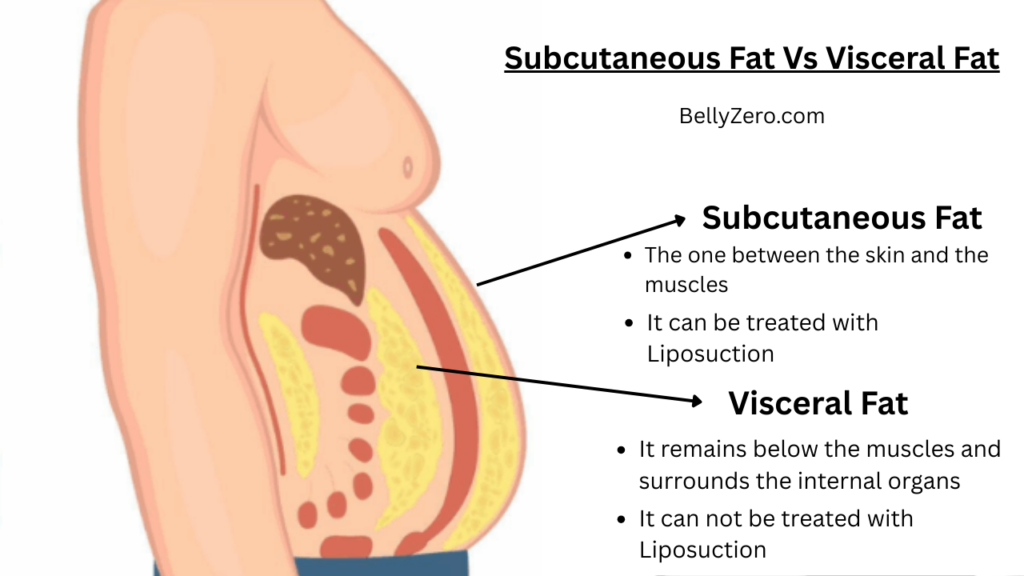
Visceral fat is the adipose tissue stored deep inside your abdominal cavity, wrapped around organs like your liver, pancreas, stomach, and intestines. You cannot see it from the outside. You cannot pinch it. It sits behind your abdominal wall, not under your skin.
This is fundamentally different from subcutaneous fat, which is the soft, pinchable fat that sits just beneath your skin. Subcutaneous fat affects how you look. Visceral fat affects how your body functions at a biological level.
The reason visceral fat is so dangerous comes down to what it does metabolically. Visceral fat cells are not passive storage tanks. They are metabolically active tissue that releases free fatty acids directly into the portal vein, which feeds straight into the liver.
This triggers a cascade of inflammatory signals, disrupts insulin signaling, and raises blood pressure, triglycerides, and LDL cholesterol, all at the same time.
| Feature | Subcutaneous Fat | Visceral Fat |
|---|---|---|
| Location | Just under the skin | Deep in abdominal cavity, around organs |
| Visible externally? | Yes, pinchable | No |
| Metabolic activity | Low to moderate | High: releases cytokines and free fatty acids |
| Health risk | Primarily aesthetic | T2DM, CVD, hypertension, certain cancers, all-cause mortality |
| Removable by liposuction? | Yes | No |
| Response to exercise | Moderate | Strong: responds faster than subcutaneous fat |
One important finding that surprises most people: research consistently shows that visceral fat responds to exercise faster than subcutaneous fat does. The bad news is it is more dangerous. The good news is it is more responsive to lifestyle change.
What Is a Healthy Visceral Fat Level?
This is where most online content gets vague. Let’s be specific. The clinical threshold that matters is 130 cm² of visceral fat area, measured at the L4/L5 lumbar vertebrae level on a CT scan.
Hunter et al. (1994, American Journal of Cardiology) set this cut-point after finding it to be the level at which risk of hypertension, dyslipidemia, and other cardiometabolic conditions begins to rise significantly in adults.
| Visceral Fat Area | Category | Clinical Meaning |
|---|---|---|
| Below 80 cm² | Very Low | Well below risk threshold |
| 80 to 129 cm² | Healthy Range | No visceral obesity. Maintain current habits. |
| 130 to 199 cm² | Visceral Obesity | Independent risk factor for T2DM, CVD, hypertension |
| 200 cm² and above | Severe Visceral Obesity | High risk for metabolic syndrome and all-cause mortality |
A critical point that BMI misses entirely: research published in Scientific Reports (2021) found that visceral fat depots can increase in people with normal weight, overweight, and obesity alike. Your BMI can be perfectly normal while your visceral fat is in the obesity range. This is sometimes called normal weight obesity or metabolically obese normal weight (MONW), and it is more common than most clinicians expect.
If you do not have access to a CT scan or DEXA scan, the Waist-to-Height Ratio (WHtR) is the most reliable home proxy for visceral fat levels. Keep your WHtR below 0.50. That means your waist circumference should be less than half your height. It is a simple rule that holds up across most populations and both sexes.
How Do You Know If You Have Visceral Fat?
Visceral fat accumulation is influenced by multiple factors including diet, physical activity, sleep, stress, and genetic predisposition. No single measurement tells the full story, but the following indicators give you a reliable picture.
You cannot see visceral fat or feel it from the outside. But your body does give you signals worth paying attention to.
The clearest home indicators are:
- Waist circumference above WHO thresholds. For men, any measurement at or above 94 cm (37 inches) signals elevated visceral fat risk. At 102 cm (40 inches), the risk is high. For women, risk starts at 80 cm (31.5 inches) and becomes high at 88 cm (34.6 inches). These are WHO 2008 consensus thresholds.
- A WHtR at or above 0.50. Divide your waist circumference by your height, both in the same unit. If the number is 0.50 or higher, your waist is proportionally large enough relative to your height to suggest elevated visceral fat.
- A firm, protruding abdomen that feels tight rather than soft. Subcutaneous fat is soft and you can pinch it easily. A belly that feels firm and rounded even when you are not bloated often indicates visceral fat pressing outward from behind the abdominal wall.
- Metabolic markers on a blood test. Elevated fasting triglycerides (above 150 mg/dL), reduced HDL cholesterol, elevated fasting glucose, or high blood pressure (the components of metabolic syndrome) are strongly associated with visceral fat accumulation.
None of these replace a scan. But if two or more apply to you, your visceral fat level is worth investigating properly, starting with the calculator above.
Can a DEXA Scan Measure Visceral Fat?
Yes, and it is currently the most practical clinical option for people who want a precise measurement outside of a hospital setting.
A DEXA (dual-energy X-ray absorptiometry) scan uses two different X-ray energies to distinguish between bone, lean mass, and fat tissue. Modern DEXA software includes abdominal visceral fat estimation as a standard output alongside body composition results. It is not as precise as a CT scan (which remains the gold standard), but it is substantially more accurate than any anthropometric calculation, including the Samouda formula.
Approximate comparison of measurement methods:
| Method | Accuracy | Radiation | Typical Cost |
|---|---|---|---|
| CT Scan (L4/L5) | Gold standard | High | $500 to $1,500+ |
| MRI | Gold standard (no radiation) | None | $1,000 to $3,000+ |
| DEXA Scan | Good (estimated VAT) | Very low | $50 to $200 |
| Samouda Formula (this calculator) | R² = 0.80 to 0.84 vs CT | None | Free |
| Waist circumference alone | Moderate proxy | None | Free |
| BMI alone | Poor for visceral fat specifically | None | Free |
If your calculator result is in the elevated or high range and you want confirmation before making significant lifestyle or medical decisions, a DEXA scan from a sports medicine clinic or private health facility is a reasonable and accessible next step.
Can Liposuction Remove Visceral Fat?
No. This is one of the most common misconceptions about abdominal fat, and it is worth being direct about it.
A landmark study published in the New England Journal of Medicine (Klein et al., 2004) examined 15 obese women who had large-volume liposuction, removing an average of 10 kg of subcutaneous fat, and measured their metabolic markers before and after. Despite the dramatic reduction in subcutaneous fat, there was no improvement in insulin resistance, blood pressure, triglycerides, or inflammatory markers. Why? Because liposuction does not touch visceral fat.
Visceral fat sits inside the abdominal cavity, wrapped around your organs. Surgeons cannot safely access it through a liposuction cannula without entering the cavity itself, which is a fundamentally different and far more invasive procedure. Standard liposuction removes subcutaneous fat, which lies between the skin and the abdominal muscle wall. These are different anatomical compartments.
There is another finding worth knowing. A randomized trial published in JCEM(2012) found that large-volume liposuction actually triggered a compensatory 10% increase in visceral fat in patients who did not exercise afterward. The body appears to compensate for the removal of subcutaneous fat by redirecting fat storage internally. The same study found that regular exercise after liposuction completely prevented this visceral fat rebound.
The takeaway: liposuction changes how you look. It does not change your visceral fat level or your cardiometabolic risk. If your concern is health rather than appearance, the only tools that reduce visceral fat are lifestyle-based.
How to Lose Visceral Fat: What the Research Actually Shows
Visceral fat responds to lifestyle intervention faster than subcutaneous fat does. That is not a motivational claim. It is a documented metabolic property. Here is what the evidence says, ranked by effect size.
Aerobic Exercise
This is the most effective single intervention for visceral fat reduction. A 2024 systematic review and network meta-analysis of 84 randomized controlled trials( Chen et al., Obestiy Reviews) found that aerobic exercise, resistance training, and HIIT all significantly reduced visceral fat in people with overweight and obesity. Aerobic exercise produced the most consistent reductions across both sexes.
Minimum effects: 150 minutes per week of moderate-intensity aerobic activity: brisk walking, cycling, swimming, or jogging. A 2024 meta-analysis of 116 randomized trials (JAMA Network Open) confirmed that 150 minutes per week is the threshold at which clinically meaningful reductions in waist circumference occur.
You do not need to exercise in one continuous session. Three 10-minute walks spaced through the day produce similar metabolic benefits to a single 30-minute session, according to data from the Luxembourg Institute of Health.
Calorie Deficit and Diet Quality
Exercise works. Diet works better when combined with exercise. A caloric deficit of 300 to 500 kcal per day produces steady visceral fat reduction without the lean mass loss that comes with aggressive restriction.
In terms of dietary pattern, the research consistently points to two changes with the largest impact:
Reduce added sugars and sugar-sweetened beverages. Dietary fructose goes almost exclusively to the liver, which converts it to fat through a process called de novo lipogenesis, with much of that fat deposited viscerally. This is why sugary drink intake is one of the strongest dietary predictors of visceral fat accumulation.
Reduce ultra-processed food consumption. Ultra-processed foods are calorie-dense, fiber-poor, and disrupt the satiety signals that normally prevent overeating. Replacing even one ultra-processed meal per day with a whole-food alternative creates measurable improvement over weeks.
Sleep
Most people underestimate this one. A randomized controlled trial published in Journal of the American College of Cardiology (2022)found that restricting sleep to 4 hours per night for just 2 weeks significantly increased visceral fat compared to a normal 9-hour sleep schedule, even when body weight did not change.
The mechanism runs through cortisol. Sleep deprivation raises cortisol levels, and cortisol preferentially directs fat storage into the visceral compartment rather than under the skin.
Seven to nine hours of sleep per night is not optional if visceral fat reduction is the goal.
Stress Management
Chronic psychological stress activates the hypothalamic–pituitary–adrenal (HPA) axis, leading to sustained cortisol elevation. A review published in Nature Reviews Endocrinology shows that elevated cortisol is strongly associated with increased visceral fat accumulation and central obesity.
Visceral fat tissue has a higher density of glucocorticoid receptors than subcutaneous fat, which makes it more responsive to cortisol and more likely to store fat under chronic stress.
Mindfulness-based stress reduction, regular aerobic exercise, and adequate sleep all help lower cortisol levels. The same lifestyle factors that reduce visceral fat also reduce chronic stress.
What Supplements Help Reduce Visceral Fat?
This section gets a lot of attention online and deserves an honest answer.
The evidence base is thin. Most supplements marketed for visceral fat loss have either been studied in very small trials, shown modest effects at best, or not been studied at all in randomized controlled trials.
The ones with the strongest (though still modest) evidence:
- Omega-3 fatty acids (EPA/DHA). Several trials show modest visceral fat reduction alongside anti-inflammatory effects, particularly at doses of 2 to 4 grams per day combined with exercise.
- Green tea extract (EGCG). Some RCT evidence suggests a small reduction in visceral fat area, though effect sizes are modest and the evidence remains mixed.
- Berberine. A few small trials show metabolic improvements including visceral fat reduction, particularly in people with insulin resistance. Quality evidence remains limited.
The honest bottom line: No supplement comes close to the visceral fat reduction produced by 150 minutes of weekly aerobic exercise and a 300 to 500 kcal daily deficit. Supplements are not a substitute.
Frequently Asked Questions
The most reliable home indicators are waist circumference above WHO thresholds (94 cm for men, 80 cm for women) and a Waist-to-Height Ratio above 0.50. A firm, rounded abdomen that does not compress easily is another sign. A DEXA scan or the Samouda-based calculator above can give you an estimated visceral fat area in cm².
Aerobic exercise produces the fastest and most consistent visceral fat reduction of any single intervention. A 2024 meta-analysis of 84 randomized trials confirmed that moderate to vigorous aerobic activity significantly reduces visceral fat area, with the effect scaling with weekly training volume. Combined aerobic exercise and caloric deficit produces greater reductions than either alone.
No. Liposuction removes subcutaneous fat, which sits between the skin and the abdominal muscle. Visceral fat sits inside the abdominal cavity around your organs and is not accessible through a liposuction cannula. A New England Journal of Medicine study confirmed that large-volume liposuction produces no improvement in the metabolic markers driven by visceral fat. One trial found liposuction can trigger a compensatory 10% increase in visceral fat in patients who do not exercise afterward.
Clinicians classify below 130 cm² of visceral fat area at the L4/L5 vertebrae level as healthy. Hunter et al. (1994) established this threshold after identifying it as the level below which cardiometabolic risk does not significantly increase from visceral fat alone. As a home proxy, keeping your Waist-to-Height Ratio below 0.50 is the most practical guideline.
No, and this surprises most people. Visceral fat is more metabolically active than subcutaneous fat, which means it responds more readily to caloric deficit and aerobic exercise. Research consistently shows that visceral fat is preferentially mobilized early in a fat-loss program, often before subcutaneous fat shows significant changes. The challenge with visceral fat is not that it is stubborn; it is that most people do not know how much they have until they check.
Most people start seeing measurable reductions in visceral fat within 4 to 8 weeks of consistent lifestyle changes. At 150 minutes of aerobic exercise per week or more, this happens even without caloric restriction. With a combined approach of moderate caloric deficit and regular exercise, clinically significant reductions of 10 to 20% of visceral fat area occur within 8 to 12 weeks. Larger reductions require sustained effort over 3 to 6 months.
No. These are distinct fat depots in separate anatomical compartments. When visceral fat is lost through exercise and caloric deficit, it gets mobilized and oxidized as fuel. It does not migrate to subcutaneous locations. The reverse is also true: subcutaneous fat does not convert to visceral fat directly.
Yes. Visceral fat is highly responsive to weight loss produced by caloric deficit, exercise, or both. Research shows that visceral fat tends to be lost earlier and in greater proportion than subcutaneous fat during a weight loss program. For example, a 5 to 10% reduction in total body weight typically produces a disproportionately larger percentage reduction in visceral fat area.
Visceral fat sits inside the abdominal cavity, in the omentum (a fatty membrane that drapes over the intestines), and between the organs, including around the liver, pancreas, stomach, and intestines. It sits behind the abdominal muscles, not beneath the skin. This is why a protruding abdomen that feels firm and taut, rather than soft and pinchable, often indicates significant visceral fat.
Excess visceral fat can contribute to back pain through two mechanisms. First, the additional anterior abdominal mass shifts your center of gravity forward, placing greater compressive load on lumbar spinal structures over time. Second, the chronic low-grade inflammation produced by visceral fat tissue associates with generalized musculoskeletal pain in several studies.
For informational and educational purposes only. All content on BellyZero, including articles, calculators, health tools, templates, and recipes, is intended to provide general health information. It does not constitute medical advice, a clinical diagnosis, or a substitute for professional healthcare guidance.
Results generated by BellyZero calculators and tools are estimates based on population-level formulas and standard reference ranges. They do not account for your full medical history, individual physiology, existing health conditions, or medications. Results may not apply to pregnant women, children, competitive athletes, or individuals with chronic illness.
Always consult a qualified healthcare professional before making changes to your diet, exercise routine, or health regimen based on anything found on this website. If you have symptoms or concerns about your health, seek medical attention promptly. BellyZero does not accept liability for decisions made based on content published on this site.
Written By: Vikas Arora Updated : May 2026